
Live Updates: Putin Threatens to Strip Ukraine of Statehood, as Russian Advance Slows

LVIV, Ukraine — As his troops continued to run into stiff resistance in Ukraine, President Vladimir V. Putin of Russia delivered an ominous message to Ukrainians on Saturday, telling government leaders they might lose their statehood and likening the withering sanctions imposed on his country to a “declaration of war.”
“The current leadership needs to understand that if they continue doing what they are doing, they risk the future of Ukrainian statehood,” Mr. Putin said. He also said any third-party countries that tried to impose a no-fly zone over Ukraine would be considered enemy combatants. Ukraine’s president, Volodymyr Zelensky, has beseeched Western countries to declare such a no-fly zone.
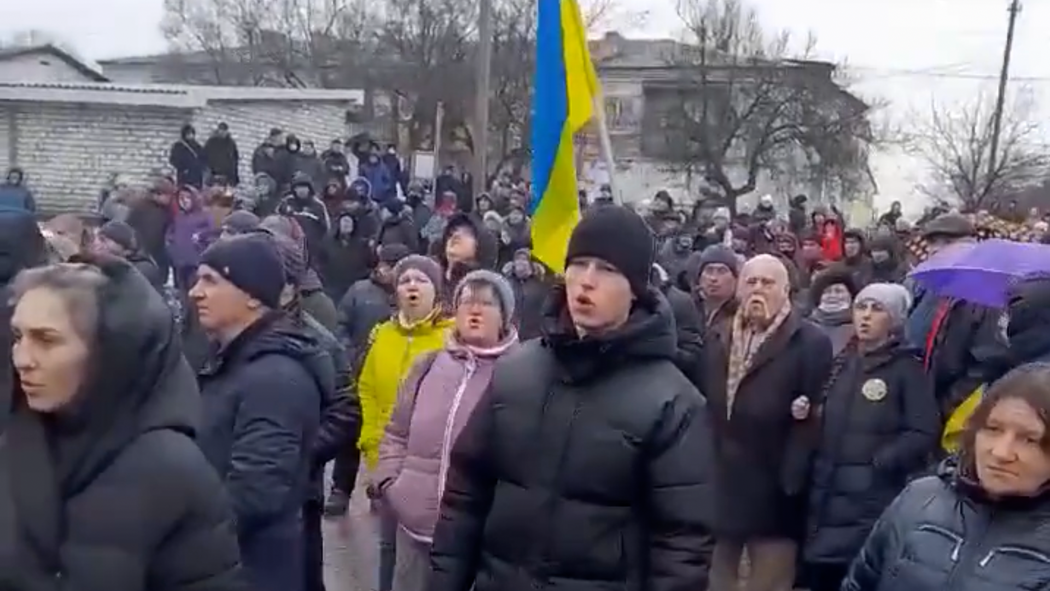
Mr. Putin issued his threats as Ukrainians across the country continued to engage in defiant displays of patriotism, even in places that have been overtaken by the Russians. In Kherson, the first major city to fall to Russian troops, hundreds of protesters gathered in the central square at 10 a.m. on Saturday, many waving Ukrainian flags, according to video streamed live from the scene and verified by The New York Times.
The besieged coastal city of Mariupol in southern Ukraine halted a planned evacuation on Saturday, accusing Russian forces of shelling the city and violating a temporary cease-fire that city administrators wanted to use to get citizens out.
Here are the latest developments:
-
Russia’s military is trying to add to its gains in the south, moving closer to the vital port city of Odessa, as it tries to cut off the Ukrainian government from the sea.
-
Outside Kyiv, there have been fierce attacks and counterattacks as Ukrainian forces battle to keep the Russians from encircling it. The vast armed convoy approaching Kyiv from the north still seems to be largely stalled, according to Western analysts, and the Ukrainian military says its forces have been attacking it where they can.
-
Prime Minister Naftali Bennett of Israel traveled to Moscow to meet with Mr. Putin, according to Israeli and Russian officials. Mr. Bennett’s office said in a statement that the meeting lasted about three hours and took place “in coordination and with the blessing of the U.S. administration.” There was no immediate information about any outcome from the meeting.
-
Since Russian forces surrounded Mariupol this week, the city has been facing a growing humanitarian crisis. It is largely impossible to bring in medical supplies and other relief. Despite daily bombardments, the local government has refused to surrender.
-
NATO members are rushing to resupply the Ukrainians with Javelin and Stinger missiles and other weapons. American shipments represent the largest single authorized transfer of arms from U.S. military warehouses to another country, according to a Pentagon official.

March 6, 2022, 2:58 a.m. ET
Reporting from Seoul
South Korea said on Sunday that it was tightening export controls against Belarus, which has provided a staging ground for the Russian invasion of Ukraine. Its foreign ministry did not release details other than to say that its restrictions against Belarus would be similar to those imposed against Russia. South Korea had earlier banned shipments of strategic goods to Russia and joined Western countries in suspending financial transactions with several major Russian banks.
March 6, 2022, 2:55 a.m. ET
Reporting from Lviv, Ukraine
Hundreds of thousands of homes across eastern and southern Ukraine had their gas turned off on Sunday because of heavy fighting, according to Ukraine’s Transmission System Operator for Gas.
The operator said it shut down 16 gas distribution stations in Kharkiv, Mykolaiv, Zaporizhzhia, Kyiv, Donetsk and Luhansk regions. “It is currently impossible to restore gas supply to some distribution stations,” the company said. Natural gas is the primary way many homes are heated and is also used for cooking.
The Ukrainian gas operator was working with suppliers in Poland and other nations to increase gas imports so the supply available to the public would be almost equal to the average daily consumption in Ukraine.

March 6, 2022, 1:52 a.m. ET
Reporting from Kyiv, Ukraine
In an address to Ukrainians on Sunday morning, President Volodymyr Zelensky praised the many forms of resistance people have chosen to oppose the Russian invasion and called his country “a superpower of spirit.” The country, he said, was performing at “the maximum of possibilities,” with soldiers fighting but also ordinary people defending towns, hospitals and fire departments. He encouraged residents of occupied areas to protest, if possible. Ten days into the war, he said, Ukraine had united with “millions of people, which became one whole.”
March 6, 2022, 12:53 a.m. ET
LVIV, Ukraine — The Ukrainian military warned on Sunday morning that Russian forces advancing north toward Kyiv could be moving to seize the dam of a key hydroelectric power station.
The threat to the Kaniv hydroelectric power station, located about 100 miles south of Kyiv on the Dnieper River, is part of what Ukrainian officials describe as a systematic effort to gain control over parts of the country’s critical infrastructure.
Since the invasion, Russian forces have destroyed, attacked or captured several energy infrastructure facilities around the country, according to the Ukrainian military, witnesses and video evidence verified by The New York Times. Russian forces took control of Europe’s largest nuclear power plant in Zaporizhzhia on Friday after a fierce battle caused a fire in a training building and sparked worldwide alarm.
One day after the fire, Ukraine’s nuclear regulator told the International Atomic Energy Agency that it had been able to maintain communications with staff at the plant. The technical safety systems are intact and radiation levels are normal at the plant, the international agency said.
While operations have normalized, the situation inside the facility remained “tense,” said Rafael M. Grossi, the director general of the agency, who called for operating staff to be allowed to rest and undergo regular shift changes.
Two out of six reactors are now operating. One telephone communication line had been lost but another was still functioning, as was mobile phone communication.
The Ukrainian authority told the agency that the facility’s training center — located separately from the reactor units — had suffered significant damage during the events on Friday. There had also been damage to the site’s laboratory building and to an administrative structure, the Ukrainians told the international agency.

March 6, 2022, 12:25 a.m. ET
Radio Free Europe/Radio Liberty, the U.S.-funded media outlet founded in the Cold War to deliver news into Communist-controlled countries, announced that it would cease its operations in Russia as the country cracks down on information following their invasion of Ukraine.
Jamie Fly, Radio Free Europe/Radio Liberty, president and chief executive said in a statement on Sunday that the move was a result of “the Putin regime’s assault on the truth.”
Since its invasion of Ukraine, Russia has moved swiftly to limit free speech and dissent, forcing Western companies to reassess. Bloomberg News, the BBC, CNN International and ABC News have also suspended their news reporting operations inside Russia. The Kremlin has blocked access to Facebook inside the country.
The suspension strikes at the heart of Radio Free Europe/Radio Liberty.
Radio Free Europe was founded by U.S. officials in 1950 and had broadcast into Eastern bloc countries including Czechoslovakia, Hungary, and Poland. Three years later, Radio Liberty, which was also founded by U.S. officials and was a separate organization, began broadcasting into the Soviet Union.
After the fall of the Soviet Union, the now united Radio Free Europe/Radio Liberty created new bureaus in countries just beginning to build their democracies. They trained journalists and tried to help develop local media.
Back then, President Vaclav Havel of the Czech Republic thanked the organization for its role during the Cold War. He even offered the former parliament building as a headquarters for Radio Free Europe.
“We need your professionalism and your ability to see events from a broad perspective,” said President Havel.
In recent weeks, Radio Free Europe/Radio Liberty said it had faced increasing pressure in Russia.
Friday, local tax officials initiated bankruptcy proceedings against one of its Russian entities, the group said. That is the same day that President Vladimir V. Putin signed a new law to punish anyone spreading “false information” about its Ukraine invasion with up to 15 years in prison.
The organization also said that it refused requests by the Russian government to delete information about the Ukraine invasion. After the refusal, Russian authorities blocked access within the country to its websites, the organization said.
In the statement, Mr. Fly said the Russian government is “now branding honest journalists as traitors to the Russian state,” adding that its journalists will “continue to tell the truth about Russia’s catastrophic invasion of its neighbor” from outside of the country.

March 5, 2022, 11:56 p.m. ET
For weeks, a Russian invasion had been feared, but once the sweeping attack began last week, hitting seemingly every corner of Ukraine, the war became unavoidably tangible for its people, a hovering cloud of darkness that once seemed unimaginable in the post-Cold War era.
Hearing the booms of missile explosions and air attacks, and reports of battles that had killed both civilians and soldiers, some vowed to fight the intruders however they could. Most also realized, though, that life defying Russia’s overwhelming might was likely to be hazardous.
In parts of Ukraine, people cleaned out grocery stores. They rushed the A.T.M.s to get their savings while they could. Many thousands waited in impossible lines for bus tickets or sat in their cars in monstrous traffic jams, seeking to head west, to NATO-protected lands. Others took up arms in volunteer militias or donated blood to their fellow citizens.
As Ukrainian forces waged intense battles for Kyiv, the capital, Kharkiv and other major cities, people waited to see what might come of an escalating war, Western sanctions against Russia and sputtering diplomacy. Photographers and videographers in and around Ukraine provide a look at a populace coping with the uncertainty and fear of a military invasion.

March 5, 2022, 11:43 p.m. ET
Reporting from Hong Kong
Two units at the nuclear power plant assaulted by Russian troops are now operating, the International Atomic Energy Agency said, adding that the Ukrainian operator reported that safety systems were intact and radiation levels remained normal. One of the plant’s six units increased operating power on Saturday, while another is already at nearly full capacity. Of the other four, one is undergoing maintenance, one is in low power mode and two are shut down.
The situation at the plant remained “tense,” said Rafael M. Grossi, the director general of the agency, who called for operating staff to be allowed to rest and undergo regular shift changes. He described the arrangement between the Ukrainian plant operators and the Russian forces that now controlled the site as a “tense” situation that “certainly cannot last for too long.”

March 5, 2022, 10:55 p.m. ET
As global condemnation of Russia’s attack on Ukraine grows, cultural institutions have moved with surprising speed to put pressure on Russian artists to distance themselves from President Vladimir V. Putin.
Institutions are demanding that artists who have supported Mr. Putin in the past issue clear condemnations of the Russian president and his invasion as a prerequisite for performing. Others are checking their rosters and poring over social media posts to ensure Russian performers have not made contentious statements about the war.
Performances around the world have been affected. In New York, Anna Netrebko, one of opera’s biggest stars, saw her reign at the Metropolitan Opera end after she declined to denounce Mr. Putin. In Toulouse, France, the music director of an orchestra — who is also the chief conductor at the Bolshoi Theater in Moscow — was instructed to clarify his position on the war before his next appearance.
Leaders of organizations are facing pressure from donors, board members and audiences, not to mention waves of anger on social media, where campaigns to cancel several Russian artists have rapidly gained traction.
They are also grappling with what to do about the Russians who are among their most important financial supporters. On Wednesday the Guggenheim Museum announced that Vladimir O. Potanin, one of Russia’s richest men and a major benefactor, was stepping down as one of its trustees.
Leila Getz, the founder and artistic director of a recital series in Vancouver, Canada, canceled an appearance by the Russian pianist Alexander Malofeev planned for August. Mr. Malofeev, 20, had not made any statements on the war, nor did he have any known ties to Mr. Putin.
In an interview, Ms. Getz defended her decision. “The first things that came to my mind were, why would I want to bring a 20-year-old Russian pianist to Vancouver and have him faced with protests and people misbehaving inside the concert hall and hooting and screaming and hollering?” she said.
Mr. Malofeev declined to comment.
In a statement posted on Facebook, he said, “The truth is that every Russian will feel guilty for decades because of the terrible and bloody decision that none of us could influence and predict.”
March 5, 2022, 10:10 p.m. ET
Reporting from Hong Kong
Germany and Israel share a common goal of ending the war in Ukraine as soon as possible, the German government said early Sunday after Chancellor Olaf Scholz met with Prime Minister Naftali Bennett of Israel. Mr. Bennett had earlier traveled to Russia to meet with President Putin for an effort at diplomacy. The 90-minute conversation between Mr. Scholz and Mr. Bennett focused on the results of those talks with Mr. Putin, but no further details were immediately disclosed.
March 5, 2022, 9:49 p.m. ET
Radio Free Europe/Radio Liberty, a media organization with roots in the Cold War, said it has suspended operations in Russia after it was targeted by local tax officials and a new Russian law aimed at stifling independent reporting. RFE/FL said its journalists will continue to “tell the truth about Russia’s catastrophic invasion of its neighbor” from outside of Russia.

March 5, 2022, 9:05 p.m. ET
The Russian government and major supermarket chains have agreed to restrict the amount of food staples sold to each customer in an effort to limit hoarding, the country’s trade ministry said in a statement Saturday. Panic buying has been intensifying across Russia as the country’s residents deal with the impact of Western economic sanctions.
March 5, 2022, 9:03 p.m. ET
Senior U.S. officials are traveling to Venezuela on Saturday to meet with the government of President Nicolás Maduro, according to people familiar with the matter, as the Biden administration steps up efforts to separate Russia from its remaining international allies over the invasion of Ukraine.
The trip is the highest-level visit by Washington officials to Caracas, Venezuela’s capital, in years. The United States broke off diplomatic relations with Mr. Maduro and closed its embassy in Caracas in 2019, after accusing the authoritarian leader of electoral fraud. The Trump administration then tried to topple Mr. Maduro’s government by imposing sanctions on Venezuelan oil exports and the country’s senior officials, and by recognizing the opposition leader as Venezuela’s lawful president.
Russia’s assault on Ukraine has prompted the United States to pay closer attention to President Vladimir V. Putin’s allies in Latin America, which Washington believe could become security threats if the standoff with Russia deepens, according to current and former U.S. officials who spoke on the condition of anonymity to discuss sensitive policy matters.
As Russia’s economy craters, the United States is seizing on an opportunity to advance its agenda among Latin American autocracies that might start seeing Mr. Putin as an increasingly weak ally. Mr. Maduro and others have begun to distance themselves since the war began: Venezuela, Nicaragua and Cuba abstained or did not vote on the two resolutions proposed at the United Nations this week to condemn Russian aggression, and the leaders of Venezuela and Cuba have called for a diplomatic solution to the crisis.
When the United States and its allies began considering imposing sanctions on Russian oil and gas exports this month to punish the country for the invasion, prominent voices affiliated with both major American political parties pointed to Venezuela as a potential substitute.
Well-connected Republicans have been involved in talks about restarting the oil trade, including Scott Taylor, a former Republican congressman from Virginia who is working with Robert Stryk, a Washington lobbyist who briefly registered to represent Mr. Maduro’s regime in 2020 and remains in contact with people around it.
March 5, 2022, 8:23 p.m. ET
As Russian forces continue their assault on Ukraine, families there are packing onto trains destined for nearby European countries, some of which have historically been reluctant to welcome refugees.
The U.N. has predicted that 10 million Ukrainians — roughly a quarter of the population — could be displaced. Some families are making their way to the Nyugati train station in central Budapest, where volunteers are distributing food and provisions. Some refugees arrived from Zakarpattia Oblast, just over the border in eastern Ukraine, and others from Odessa, a port city on the Black Sea.

March 5, 2022, 7:49 p.m. ET
The lower level of the Berlin Central Train Station has been repurposed into a welcome area for arriving Ukrainians surging into the city.
Volunteers have arrived, offering supplies, lodging and clothing, that has been neatly stacked by gender and age.
“Couch for 1 girl — 1 week,” read the sign being held up by one young woman.
An elderly German woman walked up to a Ukrainian teenager standing on a platform and pressed a 100 euro bill (about $109) into his hand, tears streaming down her cheek.
“Welcome,” she said.
Over the past few days, Berlin has become a major hub for refugees from Ukraine. Last Monday, the city administration reported finding beds for some 350 refugees. By Friday, more than 10,000 arrived in the German capital by train and bus, and city authorities are bracing for more.
The outpouring of help from ordinary Germans echoes the early days of the 2015-2016 migrant crisis, when hundreds of thousands of refugees from wars in Syria and Afghanistan found safe haven in Germany.
There was some backlash within Germany, but it subsided, the country gave asylum to far more people than its neighbors — more than one million — and the resettlement is now widely regarded as a success. It was a moment of redemption for the country that had committed the Holocaust.
But if the images are familiar, they are enhanced not just by the geographic proximity of the present war but by the memory of Germany’s Nazi past, when it brutalized both Russia and Ukraine.
“It’s an irony of history,” said Dima Chornii, a 15-year-old Ukrainian who arrived to Berlin with his family from their home in Kherson, and was departing Friday for Erfurt, a city in central Germany, where they have friends. His great-grandfather had been a Soviet Red Army soldier who died, fighting to take Berlin from the Nazis less than a week before the end of World War II. “But,” he added, “the Germans are a changed people.”

March 5, 2022, 7:20 p.m. ET
Hector, who lives in Tampa Bay, Fla., is a former United States Marine who served two violent tours in Iraq. On Friday, he boarded a plane for one more deployment, this time as a volunteer in Ukraine.
He checked in several bags filled with rifle scopes, helmets and body armor donated by other veterans. “I can help right now,” said Hector, who asked to be identified only his first name for security reasons.
Hector is part of a surge of American veterans who say they are now preparing to join the fight in Ukraine, emboldened by the invitation of the country’s president, Volodymyr Zelensky, who earlier this week announced he was creating an “international legion” and asked volunteers from around the world to help defend his nation against Russia.
David Ribardo, a former Army officer who owns a property management business in Allentown, Pa., is acting as a sort of middle man for a group called Volunteers for Ukraine, identifying veterans and other volunteers with useful skills and connecting them with donors who buy gear and airline tickets.
Fund-raising sites such as GoFundMe have rules against collecting money for armed conflict, so Mr. Ribardo said his group connects those he has vetted with people who want to donate, describing his role as being “a Tinder for veterans and donors.”
Veterans said they are driven by past experiences. Some want to try to recapture the intense clarity and purpose they felt in war, which is often missing in suburban life. Others want a chance to make amends for failed missions in Iraq and Afghanistan, and see the fight to defend a democracy against a totalitarian invader as the reason they joined the military.
On Thursday, the Russian Defense Ministry spokesman, Igor Konashenkov, told the Russian News Agency that foreign fighters would not be considered soldiers, but mercenaries, and would not be protected under humanitarian rules regarding the treatment of prisoners of war.
“At best, they can expect to be prosecuted as criminals,” Mr. Konashenkov said.
U.S. officials have been trying to steer Americans toward other methods of support. During a news conference this week, Secretary of State Antony J. Blinken said people who want to help Ukraine can do so by supporting nongovernmental organizations that are providing humanitarian assistance and “by being advocates for Ukraine and for peaceful resolution to this crisis that was created by Russia.”

March 5, 2022, 7:14 p.m. ET
Reporting from Washington
President Biden called President Volodymyr Zelensky of Ukraine on Saturday night. The White House said that Mr. Biden, who had just emerged from services at his church in Wilmington, Del., talked with the Ukrainian leader for a little more than 30 minutes. It was not immediately clear if they discussed Mr. Zelensky’s call for fighter aircraft to hold off the Russian invasion.
March 5, 2022, 6:38 p.m. ET
Mastercard and Visa said they would suspend operations in Russia, essentially severing cardholders there from transactions outside the country in response to the invasion of Ukraine.
The suspensions announced on Saturday evening will prevent Mastercards and Visa cards issued by Russian banks from working in other countries and block people with cards issued elsewhere from purchasing goods and services from companies in Russia.
But other transactions may still go through. Cards branded with the Mastercard or Visa logo that were issued by Russian banks may still work inside the country, because the transactions are handled by a local processor, officials at both companies said.
In a statement, Mastercard — which has operated in Russia for more than 25 years — said it had not made the decision lightly. “As we take this step, we join with so many others in hoping for and committing to a more positive, productive and peaceful future for us all,” the company said.
Visa said it planned to “cease” all Visa transactions within Russia “in the coming days.” A spokesman for the company said those transactions should be cut off within a week.
Al Kelly, chairman and chief executive officer of Visa Inc., said in a statement: “This war and the ongoing threat to peace and stability demand we respond in line with our values.”

March 5, 2022, 6:06 p.m. ET
Shell, Europe’s largest oil company, said Saturday that it would probably continue to buy Russian crude oil to feed into its refineries and supply customers with gasoline and diesel but would donate any profits to a fund dedicated to “the people of Ukraine.”
Shell had said on Monday that it was pulling out of operations in Russia. It issued a statement on its oil purchases on Saturday, a day after an article in the Financial Times revealed that the company had bought a cargo of Russian crude oil.
Shell said in the statement that it understood that governments wanted energy flows to continue from Russia for the time being. The company described the purchase of the oil as “a difficult decision” taken to “avoid disruptions to market supply.”
It went on, “Without an uninterrupted supply of crude oil to refineries, the energy industry cannot assure continued provision of essential products to people across Europe in the weeks ahead.”
Russia is one of the world’s largest oil exporters, and many refineries, especially in Europe, are probably configured for processing some Russian crude. “Cargoes from alternative sources would not have arrived in time” to avoid interruptions in supply, the company added.
The imbroglio shows the difficulty that oil companies and governments are having in calibrating their response to the invasion of Ukraine. Governments have been trying to impose sanctions on the Russian economy without disrupting flows of oil and natural gas. The idea is to punish Russia without inflicting pain on consumers in Europe, which is highly dependent on both Russian natural gas and oil, and the United States. Achieving these goals will probably prove difficult. Already, most buyers are shunning Russian oil, which is selling at a substantial discount.
Shell announced on Monday that it would pull out of joint ventures with Gazprom, the Russian natural gas monopoly, including a liquefied natural gas facility on Sakhalin Island in Russia’s Far East. Shell also said that it would end its involvement with the Nordstream 2 natural gas pipeline from Russia to Germany, a project that has been completed but was blocked.
Those moves, which will take time to be fully carried out, may not be sufficient to satisfy public opinion. Shell said that it would buy alternatives to Russian crude when possible, but completely dropping Russian oil could not happen overnight.
It ended its statement on Saturday by saying it would work with aid groups and humanitarian organizations to determine where best to put the money from its Russian oil fund “to alleviate the terrible consequences that this war is having on the people of Ukraine.”

March 5, 2022, 5:42 p.m. ET
WASHINGTON — The International Monetary Fund warned on Saturday that the war in Ukraine could inflict significant damage on the global economy, disrupting markets and trade and adding to inflationary pressures.
The warning came as Russia’s invasion of Ukraine continued to escalate. The United States and European allies have imposed sanctions on major Russian financial institutions, its central bank and oligarchs, severing much of its economy from the rest of the world.
“The ongoing war and associated sanctions will also have a severe impact on the global economy,” the monetary fund said in a statement on Saturday.
The fund’s executive board convened for a meeting on Friday that was led by Kristalina Georgieva, the managing director of the fund, to assess the economic impact of the war. The board is expected to meet again next week to consider a request from Ukraine for $1.4 billion of emergency financing.
The war presents a new round of economic challenges for a global economy that is emerging from the coronavirus pandemic and grappling with disrupted supply chains and high levels of inflation.
“In many countries, the crisis is creating an adverse shock to both inflation and activity, amid already elevated price pressures,” the monetary fund said.
The fund noted that Ukraine had already faced enormous damage to its physical infrastructure and that asset prices in Russia, including the value of the ruble, were down sharply as a result of sanctions. Countries with close economic ties to Russia and Ukraine could feel the effects of the tumult, the fund said.
The World Bank is also working to deploy economic assistance to Ukraine, and David Malpass, the bank’s president, spoke to the country’s president, Volodymyr Zelensky, on Friday. Mr. Malpass said he was submitting a request to the bank’s board for a $500 million supplemental loan to help support Ukraine’s economy.
March 5, 2022, 5:23 p.m. ET
Videos verified by The New York Times appear to show Russian-backed separatists in a small town in eastern Ukraine firing on protesters, striking one in the leg.
The shooting occurred around 1 p.m. Saturday outside a law enforcement building in Novopskov, north of Luhansk and near the Russian border, according to a witness and a Times analysis of the videos.
In one video, as the protesters chant “Ukraine, Ukraine,” a shot can be heard, and a man at the front of the crowd falls down clutching his leg. He is helped away by other protesters.
The regional governor wrote on Facebook that three people had been wounded in the shooting and were in the hospital.
The soldiers in the video appear to be Russian-backed separatists from the self-declared enclave known as Luhansk People’s Republic, which claims the region. They are wearing helmets that look similar to those worn by other separatist forces, and are not wearing the uniforms or insignia of Russian troops.
“Do you have any miners among you from the L.P.R.,” one protester asks the soldiers, referring to the region’s coal miners.
The video of the shooting was first geolocated by an open source researcher on Twitter.
The shooting occurred at the same location where a crowd gathered to protest on Friday. “War and death are coming for you,” those protesters yelled at the soldiers. “Get dressed and leave.”
Olga Dzyurak contributed translation.
March 5, 2022, 5:04 p.m. ET
The crush of Ukrainian women and children fleeing their country has already set a new European record since the end of World War II. And, as Russian attacks intensified on Saturday, it grew even bigger.
On Saturday, the Polish city of Przemysl, a 20-minute drive from the Ukrainian border, was transformed into a hub for exhausted refugees pouring out of their country, with their children and pets in their arms. Many were planning trips further into Europe.
Meanwhile, the train station in Ukraine’s western city of Lviv was choked with worried travelers, both arriving from besieged areas and desperately trying to flee the country.
Click on each photo for more information.
March 5, 2022, 4:36 p.m. ET
While technology giants like Apple and luxury retailers like Hermès have quickly moved to pause sales or shutter stores in Russia over the invasion of Ukraine, most U.S. food companies and fast-food chains have remained open — and largely silent.
Many large food manufacturers, including PepsiCo and Coca-Cola, and fast-food chains like McDonald’s and Yum Brands are facing growing pressure on social media platforms and from large investors to halt operations in Russia.
Companies “need to consider whether doing business in Russia is worth the risk during this extraordinarily volatile time,” the chief of one big investor, New York state’s pension fund, said on Thursday.
McDonald’s, Coca-Cola, PepsiCo and Mondelez International, the maker of Oreos and Ritz Crackers, did not respond to messages seeking comment about their operations in Russia. Starbucks and Yum Brands, whose chains include KFC and Pizza Hut, have said in response to the invasion that they were supporting humanitarian relief efforts.
But unlike the retailers who have announced that they’re pausing operations in Russia, some fast-food companies do not actually own the restaurants that operate there under their names. In Russia, Starbucks, Papa John’s and Yum Brands chains including KFC and Pizza Hut are mostly run by franchisees, who often have close ties to Russian banks or investors.
Franchise experts say that, depending on the agreements, it is probably up to the franchise owner to decide whether to close a restaurant because of political turmoil, rather than the brands themselves.
Fast-food restaurants and food and beverage companies were some of the earliest entrants into the Russian market, and many have nimbly operated there for decades. Even during other times of political turmoil and tensions, the companies still found consumers eager to buy American soda and gobble up burgers, chicken and pizza.
When McDonald’s opened its first restaurant in Russia — in Moscow’s Pushkin Square in 1990 — an estimated 30,000 Russians lined up to sample its hamburgers for the first time. A few years later, Mikhail Gorbachev, the former leader of the Soviet Union, appeared in a commercial for Pizza Hut.
Unlike other chains, McDonald’s owns the vast majority of its 847 restaurants in Russia. According to a page for investors, Russia accounts for 9 percent of the company’s total revenues and 3 percent of its operating income.
McDonald’s has made no statement about the invasion. A company spokesman did not respond to questions about whether its restaurants in Russia were open, and how they are receiving supplies or handling payments. Global logistics and freight firms have halted shipments to Russia and access to critical international financial and payment systems is shut down in the country.
PepsiCo has also not made a statement about its operations in Russia, and spokesmen did not respond to multiple emails seeking comment. The company says on its website that it is the largest food and beverage manufacturer in Russia, has invested hundreds of millions of dollars in three manufacturing plants in the country. Last year, Russia accounted for $3.4 billion, or more than 4 percent, of PepsiCo’s $79.4 billion in revenues.
PepsiCo struck an agreement in the early 1970s that allowed Russia to bottle Pepsi, becoming the first American consumer product manufactured and sold in the Soviet Union. In exchange, a company subsidiary, which already marketed Soviet vodka, got the exclusive rights to also sell Soviet champagne, wine and brandy in the United States. In the late 1980s, the Soviets, in renewing their agreement with PepsiCo, gave it a fleet of ships.
In a statement to global employees on Friday, the chief executive of Starbucks, Kevin Johnson, condemned the “unprovoked, unjust and horrific attacks” on Ukraine by Russia.
Mr. Johnson added that the company would donate any royalties it receives from its operations in Russia to humanitarian relief efforts in Ukraine along with other financial contributions. On Saturday, a cheery website for Starbucks in Russia, which is operated by the Kuwaiti conglomerate Alshaya Group, showed the roughly 130 stores in the country open and operating with normal business hours.
Yum Brands, which has more than 1,000 KFCs and 50 Pizza Huts in Russia — all owned and operated by franchisees — said it was making financial donations to various humanitarian relief organizations.
As for the operations in Russia, the company said in a statement that it is “monitoring the evolving situation very closely” and that it was too early to discuss the impact.
March 5, 2022, 3:56 p.m. ET
The White House effort to design a strategy to confront Russia over its invasion of Ukraine is linked to an urgent re-examination by intelligence agencies of President Vladimir V. Putin’s mental state. The debate is over whether his ambitions and appetite for risk have been altered by two years of Covid isolation, or by a sense that this may be his best moment to rebuild Russia’s sphere of influence and secure his legacy. Or both.
Throughout the pandemic, Mr. Putin has retreated into an intricate cocoon of social distancing — though he allowed life in Russia to essentially return to normal. The Federal Protective Service, Russia’s answer to the Secret Service, built a virus-free bubble around Mr. Putin that far outstrips the protective measures taken by many of his foreign counterparts.
Mr. Putin has been holding most of his meetings with government officials by video conference, often appearing in a spartan room in his Moscow estate, Novo-Ogaryovo. Even when foreign dignitaries arrived, they sometimes didn’t get to see Mr. Putin in person; the secretary general of the United Nations, António Guterres, had to make do with a video meeting when he visited Moscow last year.
Now Mr. Putin has in-person visitors — including the Israeli prime minister, Naftali Bennett, who met with Mr. Putin for about three hours on Saturday. (Mr. Putin’s residence and the Kremlin are outfitted with disinfectant tunnels that all visitors must pass through.)
Some of the world leaders who have met with Mr. Putin in recent diplomatic overtures were seated 20 feet from him at a behemoth of a table, having refused to submit to Russian P.C.R. tests that would make their DNA available to the Russians. Otherwise, people who meet him face-to-face generally have spent as long as two weeks in quarantine first.
Mr. Putin’s extreme caution reflects not only his age — he is 69, putting him at relatively high risk of severe illness from the coronavirus — but also what critics describe as paranoia honed during his former career as a K.G.B. spy.
And the Russian leader’s tendency, American intelligence officials have told the White House and Congress, is to double down when he feels trapped by his own overreach. So they have described a series of possible reactions, ranging from indiscriminate shelling of Ukrainian cities to compensate for the early mistakes made by his invading force, to cyberattacks directed at the American financial system, to more nuclear threats and perhaps moves to take the war beyond Ukraine’s borders.
Powered by WPeMatico