
Canadian-made parts found in Iranian attack drones used by Russia in Ukraine
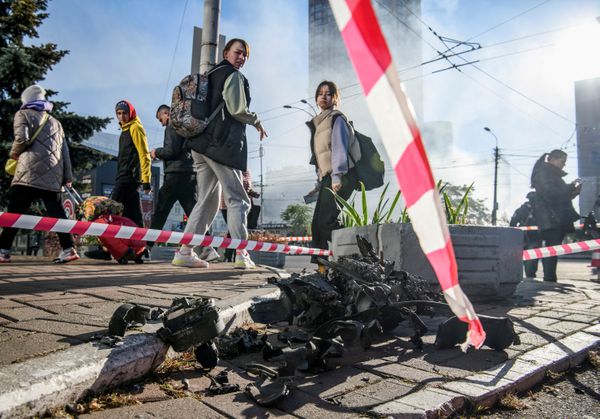
:format(webp)/cloudfront-us-east-1.images.arcpublishing.com/tgam/CVXS6SLPYFOYJLHG3SED4COVOU.JPG)
Local residents look at parts of an unmanned aerial vehicle (UAV) after a Russian drone strike in Kyiv on Oct. 17.STRINGER/Reuters
An investigative project by a Kyiv think tank has identified Canadian-made parts in one type of attack drone used by Russia in its military assault on Ukraine.
Statewatch says it has found antenna components from Ottawa-based Tallysman Wireless in Iranian-made Shahed 136 drones that form part of Russia’s arsenal in its invasion of Ukraine. The investigation, led by Inna Popovych, a Ukraine investigative journalist, was undertaken by a Statewatch project called Trap Aggressor.
The Shahed 136 drones, also called kamikaze or suicide drones because they are destroyed when they deliver their explosive payload, have been used against Ukrainian soldiers, civilians and infrastructure.
Reached in Ottawa, Tallysman’s president, Gyles Panther, told The Globe and Mail that the company has “become painfully aware” that some of its components are being “misused in sophisticated military guidance systems” in Russia’s war on Ukraine.
“It is sometimes assumed that we are somehow complicit in this usage. We absolutely are not,” Mr. Panther said. “Tallysman is 100-per-cent committed to supporting Ukraine in the face of Russian aggression.”
He said the company does not sell any of its products to Iran or Russia and its distribution network is prohibited from selling to countries, individuals or entities that are the target of sanctions. It also does not sell its goods to third parties, which to Tallysman’s knowledge supply products to these countries, he said.
Mr. Panther said Tallysman is co-operating with Canada Border Services Agency and other government agencies and he said he believes that the antenna parts in question were likely diverted to Iran through distributors using “fake company fronts” to hide their intention.
The Decibel: How to fight drones in Ukraine
Canadian-made drones show promising new technology for demining efforts in Ukraine
Tallysman is one of many Western tech companies whose products – in many cases relatively simple electronic components – have ended up in weapons manufactured by Russia and its allies.
The Statewatch Trap Aggressor investigation into the Shahed 136 drones identified 30 Western-made components from countries including Japan, Germany and the United States. The probe was conducted in partnership with Ukraine’s Independent Anti-Corruption Commission (NAKO).
While some of this Western technology is subject to export controls, much, like the Tallysman antenna components in question, are not.
That’s because simple components are not normally deemed sensitive equipment by Western governments looking to stem the flow of military goods to unfriendly states.
Mr. Panther said the company is “now hypervigilant about what products we sell to whom” and, to the extent possible, examine the identities of its customers and the end use they intend for Tallsyman products.
The same type of antenna components can be found in consumer satellite navigation devices for everything from vehicle fleet management to survey equipment, Mr. Panther said.
Kelsey Gallagher, a researcher with Project Ploughshares, an arms-control advocacy group based in Waterloo, Ont., said it’s much easier to track the international movement of goods for which an export permit is required. It would be excessively unwieldy however to require companies to obtain government permits for all their electronic exports, he said.
So how can companies prevent their technology from ending up in the hands of dangerous states such as Iran or Russia?
“It’s a difficult question,” Mr. Gallagher said. He suggested engines that can be used in military drones should require an export permit.
In some cases, however, Russia and other states have proven adept at skirting export controls.
In an August report, the Royal United Services Institute (RUSI), a British defence think tank, detailed the extent to which Russia’s military modernization program relied on the extensive use of microelectronics manufactured in at least nine Western countries.
It discovered at least 450 different kinds of unique foreign-made components in Russian military systems, the majority of which were manufactured by U.S. companies. Of these, at least 80 different kinds of components were subject to export controls by the U.S., “indicating that Russia’s military-industrial complex has, in recent decades, been able to successfully evade these,” the report said.
Powered by WPeMatico