

Religion, drone warfare and a new base: 7 takeaways from Hegseth’s speech
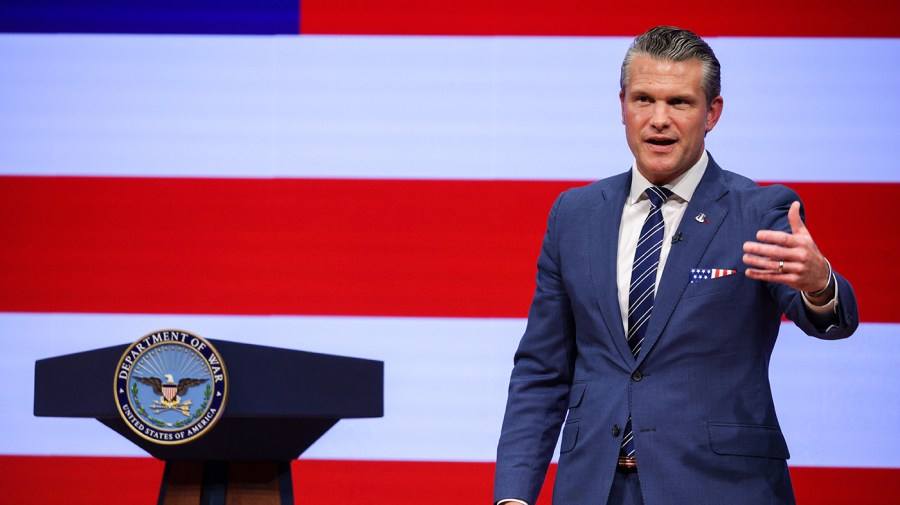
Defense Secretary Pete Hegseth made a flurry of announcements during a wide-ranging speech to active-duty officers Wednesday.
At the beginning of the address, the Pentagon chief stuck to his bread and butter: culture-war grievances, stripping the “woke” out of the Department of Defense (DOD), bashing the news media for its coverage of the Iran war, and proclaiming the “warrior ethos” has been revived and the U.S. military has been “rebuilt.”
But the Defense secretary made several newsy announcements that lean into Hegseth’s elevation of faith, create a combatant command, partner the Pentagon with different universities and tease a new domestic military base for which governors will compete.
Here are the takeaways from Hegseth’s 52-minute speech at Marine Corps Base Quantico in Virginia:
New combatant command focused on autonomous warfare
Hegseth announced the formation of a new four-star combatant command focused on developing autonomous warfare like drones and defense robotics.
The Defense secretary said it would have “service-like authorities built to scale autonomous and robotic capabilities across the joint force in the fastest peacetime shift in modern military history,” with the aim of being operational by Oct. 1 next year.
The Autonomous Warfare Command, or “AutoWarCom,” will be initially led by Owen West, a former Marine who is now the director of the Pentagon’s Defense Innovation Unit, and Max Strasiser, a Navy SEAL senior chief. Later, a four-star military leader will be announced.
“This command will possess directed manpower, budget, acquisition authorities and create dedicated military career pathways for Officers and Enlisted personnel,” Hegseth said in a Wednesday memo.
The new command will test equipment and force designs with “realistic opposition” in exercises and rugged environments to figure out what works on the battlefield, the Defense secretary said in the memo.
Project Meridian and warfare’s future
Hegseth revealed that SpaceXAI CEO Elon Musk, Anduril co-founder Palmer Luckey and former Speaker Newt Gingrich (R-Ga.) will lead a new Pentagon effort to study the future of warfare, dubbed Project Meridian.
The Pentagon chief said the project is meant to harness America’s innovators, senior leaders and technologists to look decades into the future and “forecast the creative solution for tomorrow’s conflicts.”
“It is futuristic on purpose,” he said of the project, which he clarified was not meant to develop new strategies or policies.
“We should have the humility to recognize that the best forecasters of future conflict do not solely reside inside the Pentagon,” Hegseth said. “There are obvious biases and risks to asking ourselves to both ask the questions and answer them.”
Hegseth said Musk, Luckey and Gingrich, under the leadership of Under Secretary of Defense for Research and Engineering Emil Michael, “will be focused on discovering, developing, and fielding the weapons and systems that our children and our grandchildren will need in their lifetimes, without any creative limitations or restrictions, on any future battlefield, from under the Earth to beyond the moon.”
All three men were in attendance at the Pentagon as Hegseth made his announcement, and the Pentagon chief said their first meeting on Project Meridian would happen immediately following the event in a sensitive compartmented information facility in the building.
States invited to bid for ‘next great American’ base
Hegseth invited governors to bid for their state to be the home of the “next great American” base.
“We’re calling on every governor in the country and adjutant general, every tag across this great republic, to step up to the plate and bring us their best sales pitch,” the Defense secretary said.
“If your state wants the honor of hosting 15,000 to 25,000 of America’s great troops, show us why and how you’re going to do it, cutting through the red tape, offering up the land and rolling out the red carpet for our military families,” he said during the speech.
Naval Station Everett in Washington state was the most recent base built inside the U.S., opening in the 1990s. The base is home to several guided-missile destroyers and Coast Guard ships.
Hegseth said the new base will not be a “soulless government installation,” arguing the Pentagon will “plan out and chart out a dynamic, self-sustaining power projection platform.”
The Pentagon said the base will be off the commercial grid, featuring independent power generation, autonomous systems and advanced air defenses.
“We’re talking hundreds of thousands of acres with organic power generation, modern air defenses, and cutting-edge technology, think a fortress,” the secretary said. Service members will have “first-class barracks, world-class training facilities, and thriving communities with top-tier housing, school, childcare and healthcare for families.”
Hegseth directed Dale R. Marks, who is assistant secretary of Defense for energy, installations and environment, to lead the Pentagon’s effort to identify, evaluate, select and prepare an optimal site for the base.
“Rapid advancements in disruptive technologies, growing strategic alignment among peer adversaries, and persistent, sophisticated cyber intrusions against critical defense and homeland infrastructure necessitate a modernized, resilient posture,” the Defense secretary said in a Wednesday memo.
‘Fortress America’ takes bases off civilian grid
Another new initiative revealed Wednesday is “Fortress America,” which Hegseth claimed will be “a national insurance policy for the American homeland.”
Under Fortress, which stands for “Federal Operations for Resilience, Troop Resources, Energy Supply and Survivability,” every major military installation in America would generate its own power independent of the civilian grid, according to Hegseth.
“If an adversary takes down the grid by cyberattack, by sabotage, or by any means, our bases stay lit. Our aircraft keep flying. Our command centers never go dark,” he said.
The effort also is meant to bring critical supply chains home, including rare earth minerals, specialty metals, semiconductors and propellants “mined in America, refined in America, built in America by American workers.”
In addition, the Pentagon would build up strategic reserves of such critical needs as munitions, fuel, medicine and blood “deep enough that if the world’s supply lines break — and in a real war, they’re going to break — America keeps fighting anyway,” Hegseth said.
To accomplish this, Hegseth said the U.S. military is “hardening every installation on American soil against cyber intrusion, sabotage and drones, and we’re securing the high ground and the airwaves, our satellites, our spectrum,” claiming that the DOD “will be the insurance policy for the entire nation.”
New non-Ivy League partnerships for cadets
The Defense secretary also said the Pentagon will partner with five more colleges to broaden the corps of cadets.
The military training program, called “America’s Corps of Cadets,” will include Louisiana State University, Liberty University, Tuskegee University, Mississippi State University and Hillsdale College.
“We need more officers from academic institutions like our military academies and senior military colleges, and today we’re going to make that happen,” Hegseth said.
Each school will be a “distinguished military college” and will be expected to “maintain exceptionally high standards of cadet discipline, tactical instruction and military organization,” the Pentagon chief said.
Military academies like West Point, Naval Academy and Air Force Academy commission most of the officers into the U.S. armed forces, followed by senior military colleges like Texas A&M and the Citadel.
Hegseth’s office will begin implementation within 30 days, and within four months, Under Secretary of Defense for Personnel and Readiness Anthony Tata will transition to become the primary office responsible for the program, according to a Wednesday Pentagon memo.
“From the Ivy Leagues to the most liberal arts colleges, our colleges and universities have become anti-American DEI [diversity, equity and inclusion] worshipping woke factories. Qualities like grit and courage replaced with political correctness and social justice,” Hegseth said. “God and country traded for Che Guevara and critical theory.”
Creates Office of Religious Affairs
In his last proclamation, Hegseth declared he will establish the Office of Religious Affairs at the Pentagon that “will report straight to the top.”
“Cutting-edge technology … new basing and bases … and a better educational pipeline are still incomplete without the most essential component of our republic: faith,” he told the assembled service members.
He said the Defense Department has “a sacred duty” to provide troops with “first-class religious support” wherever they’re sent, bashing past administrations for treating the topic as an afterthought.
“Political correctness and secular humanism got a vote. Chaplains did not. Budgets were cut. Resourcing and manpower needs were ignored. Base chapels fell apart,” Hegseth claimed. “Decisions about faith and religion were made by secular careerists in cubicles and lawyers running around with red tape.”
Starting Wednesday, the Office of Religious Affairs will have “a direct line to the secretary” and will “protect budgets, demand infrastructure, and strengthen religious support,” he said.
Hegseth frequently invokes his faith and has declared service members’ spiritual health as “equally important” as their physical and mental health.
Earlier this year he revamped the U.S. military’s Chaplain Corps, announcing that the officers will no longer wear their rank insignia, instead displaying insignia that reflects their religious affiliation — part of two major changes to the group.
Hegseth defends officer cuts
At the start of his speech, Hegseth defended his plan to cut 20 percent of generals and admirals at the Pentagon, arguing the major shake-up was long overdue at the department.
“Now the media calls that a purge. I call it accountability and long overdue, and frankly, the bare minimum. As usual, what the media levels as an accusation, I wear as an accomplishment,” Hegseth said.
“You see, you can’t change a culture with the same people who enabled it,” he said. “Personnel is policy at every single level.”
The move will impact senior leadership positions across the Army, Navy and the Air Force, coming a year after Hegseth oversaw a 10 percent reduction of general officers.
The move comes as he has already fired or pushed out more than two dozen senior military officers across the service branches, personnel changes that have unnerved congressional lawmakers on both sides of the aisle.
“You see, last year’s speech was not for those generals,” Hegseth said during the speech. “It was for you, the backbone of our force, the current and future leaders on the front lines.”
Copyright 2026 Nexstar Media, Inc. All rights reserved. This material may not be published, broadcast, rewritten, or redistributed.
For the latest news, weather, sports, and streaming video, head to The Hill.This article originally appeared on The Hill at https://thehill.com/policy/defense/6121765-pete-hegseth-takeaways-command-warfare-base/
Powered by WPeMatico