
As Russia Increases the Size of Its Army, Both Sides Dig In for a Long Conflict
President Vladimir V. Putin’s decision this week to expand the size of his military offered further evidence for a conviction taking hold in both Russia and Ukraine: The two sides are settling in for the long haul in a war that could last another year, or longer.
Mr. Putin, secure in his power and having silenced dissent, appears to have little incentive to stop the war, which he has now waged for more than six months without declaring a nationwide draft that could have provoked domestic discontent.
President Volodymyr Zelensky of Ukraine, warning his nation on Friday that the coming winter would be “the most difficult in our history,” is being bolstered by a largely unified West and a defiant populace in his insistence that there will be no compromise with an invading army.
The conflict has settled into a war of attrition, with little movement along the front line in recent weeks, even as both Mr. Zelensky and Mr. Putin face growing political pressure to show results on the battlefield.
Ukraine has held off from mounting a large-scale counteroffensive despite claiming for months that one was coming, and Russia has avoided sharply escalating its assault despite warning that it would retaliate against Ukrainian attacks in the Russian-controlled peninsula of Crimea.
“Expectations that this will end by Christmas or that this will end by next spring” are misguided, said Ruslan Pukhov, a defense analyst who runs the Center for Analysis of Strategies and Technologies, a privately-owned think tank in Moscow.
Ukraine, benefiting from a continuing flow of Western weapons like the $3 billion package that President Biden pledged this week, has the resources and morale to continue to resist the Russian assault. Russia, fighting the war at peacetime strength without mass call-ups of military-age men, appears to have the resources to keep waging a brutal war of attrition — but not to mount a decisive new offensive.
The largely static period on the battlefield coincides with increasing expectations — fueled by Ukraine itself — that Mr. Zelensky’s military will mount some kind of significant offensive, to show that it can make good use of Western-provided weapons and reassure allies that the economic sacrifices they are making will pay off.
Mr. Putin, as well, faces domestic pressure from far-right nationalists who want stepped-up aggression in Ukraine, particularly after recent strikes on Crimea and the killing of the ultranationalist commentator Daria Dugina in a car bombing last weekend. But the Russian leader, in control of the state media and the political system, is well-situated to ignore such calls, analysts say.
Instead, Mr. Putin insists that his forces are advancing in eastern Ukraine’s Donbas region “step by step.”
However, Russia has failed to capture a single major population center since early July. And for Mr. Putin, who justified the invasion by falsely claiming that Ukraine was committing a “genocide” of Russian speakers in the Donbas, anything short of full control of the region would be seen as a major defeat.
Mr. Putin’s decree on Thursday raised the target number of active-duty Russian service members by 137,000, to 1.15 million.
In the Russian state media, the message that Russia could only be at the start of a long and existential war against the West — now being fought, by proxy, in Ukraine — is sounding with increasing clarity. It is a shift from the messaging six months ago, when Ukrainians were depicted as lacking the will to fight and eagerly awaiting Russian “liberation.”
“We will have fewer Russian tourists in Europe, but the size of the Russian army will increase by 140,000 regular servicemen,” Igor Korotchenko, the editor of a Russian military journal, said on a state television talk show on Thursday. “I expect that this is just the beginning.”
Milana Mazaeva contributed reporting.
As the bloody artillery battle in Ukraine’s east settles into a stalemate, the war appears now to be a waiting game for a long-promised Ukrainian counteroffensive.
The timing for any move to break the deadlock has emerged as a pivotal strategic decision for Ukraine’s government. Both sides are preparing for a protracted war, but Ukraine has greater incentive to try to avoid it by undertaking risky maneuvers as early as this fall — before the rainy season closes the window on possible offensives over open fields.
From the Ukrainian perspective, the mostly static trench fighting cannot go on indefinitely. Leaving Russia in control of much of the southern coastline would cripple Ukraine’s economy, already cratering from the war and propped up by Western aid.
The initial target of any counterattack is widely assumed to be Russian positions on the western bank of the Dnipro River. Move too soon, though, and the Ukrainian army may prove unready and insufficiently armed to ensure victory, military analysts say. Wait too long, and political backing in Europe may waver as energy prices soar.
Political pressure is mounting for President Volodymyr Zelensky of Ukraine to make a move even as it remains unclear whether his military has amassed the necessary weaponry and manpower.
“The very difficult state of our economy, the constant risks of air and missile attacks and the general fatigue of the population from the difficulties of war will work against Ukraine” over time, Andriy Zagorodnyuk, a former minister of defense, wrote in the Ukrainska Pravda newspaper. He said the military should be prepared to advance, rather than defend.
“It makes no sense to drag out the war for years and compete to see who will run out of resources first,” he wrote.
The Ukrainians pivoted to a new strategy of so-called “deep war” — hitting targets far behind the front — after months of grim artillery duels and street fighting in the eastern region of Luhansk, which ultimately fell under Russian control by early July.
Using long-range, precision guided rockets provided by the United States, the Ukrainian military has been softening up Russian positions behind the front line while also striking the Russian-occupied Crimea Peninsula.
The Ukrainian government has said that, since late June, it has hit at least 154 ammunition depots, 91 bases for weapons storage, four barracks housing soldiers, four fuel depots and eight command posts. Those claims could not be independently verified.
But Ukraine has for months been telegraphing plans for the major battle in the south — with the types of weapons it has requested from Western allies and the strategies it pursues on the battlefield offering clues to its approach.
A recent U.S. military assistance package tellingly included mine-clearing attachments for armored vehicles that would be used in an advance, suggesting preparations for attacks on Russian lines.
But more time would bring more Western weaponry: Despite the arrival of artillery systems from NATO members, Ukraine’s arsenal is still largely made up of legacy Soviet arms.
At home in Ukraine, Mr. Zelensky has broad support for continuing the war. An opinion poll by the Razumkov Center, a policy research organization in Kyiv, released on Monday showed 92 percent of Ukrainians are confident in a military victory over the Russian army.
But Russian plans to stage referendums in occupied territory could lead to a claim of annexation as early as next month, putting additional time pressure on Mr. Zelensky to launch an offensive.
The State of the War
KYIV, Ukraine — Ukraine’s largest nuclear plant was reconnected to the national power grid on Friday afternoon, but its time offline renewed concerns about the safe operation of the plant and the consequences for millions of Ukrainians if there are further interruptions to power.
Ukrainian engineers were able to restore damaged external power lines after repeated shelling on Thursday, ensuring the facility was able to meet its own power needs and continue to operate safely, according to Ukrainian and international officials, but efforts to reconnect it to the grid took longer.
With fires raging around the plant, new shelling in and around the facility on a near daily basis and an exhausted and stressed team of Ukrainian engineers tasked with keeping the Zaporizhzhia Nuclear Power Plant running safely, however, calls for international intervention grew louder.
“Nowhere in the history of this world has a nuclear power plant become a part of a combat zone, so this really has to stop immediately,” Bonnie Denise Jenkins, the State Department’s under secretary for arms control and international security, told reporters in Brussels on Thursday. Russian actions, she said, “have created a serious risk of a nuclear incident — a dangerous radiation release — that could threaten not only the people and environment of Ukraine, but also affect neighboring countries and the entire international community.”
President Volodymyr Zelensky of Ukraine used his nightly address to underscore the risks, saying emergency systems had worked on Thursday, but that, had they failed, the country, and the world, would be contending with a nuclear accident.
And though the immediate threat appeared to have been averted, the disconnection of the plant from the national grid caused widespread power outages across southern Ukraine, adding to the misery wrought by the war. When fully operational, the plant provides electricity for some 20 percent of the country, including roughly four million homes.
The Zaporizhzhia regional government said that as of Friday morning, energy supplies were “partially restored” from other sources. Residents across the region reported widespread power outages overnight and into the morning.
The plant was reconnected to the Ukrainian grid at 2:04 p.m., according to Ukraine’s nuclear energy agency, Energoatom. The agency, in a statement, praised the workers at the plant who “tirelessly and firmly hold the nuclear and radiation safety of Ukraine and the whole of Europe on their shoulders.” It was not immediately clear how many people were still without power.
Ukrainians in occupied areas are already living under difficult conditions. In eastern Ukraine, Russian bombardments and fierce fighting have destroyed nearly all of the infrastructure needed to provide heat, power and clean water, leading the Ukrainian government to order a mandatory evacuation of the less than 200,000 people still living in the eastern Ukrainian region known as Donbas.
The situation in the occupied south is more complicated. Many of the towns and cities there fell in the first days of the war and were spared the widespread destruction witnessed in the east. But if the nuclear plant were to go offline again, the power for hundreds of thousands living in occupied territories could be compromised.
“The south of Ukraine — the occupied areas — is already in a state of humanitarian disaster,” Mr. Zelensky said. “In addition to all the evil that the occupiers brought there, electricity, water and sewage were cut off.”
Though the plant’s disconnection from the national grid appeared to be the related to nearby fighting, Ukrainian officials have been warning for weeks that Moscow wants to divert the power from the plant for its own needs by disconnecting it from the Ukrainian grid and then reconnecting it to the Russian grid, a potentially complicated process in a war zone that leaves room for an accident.
Ms. Jenkins, the State Department official, said the U.S. is working through the United Nations Security Council to persuade Moscow not to attempt such a potentially risky move.
“We don’t want that to happen,” she said. “We are continuing to talk with Russia and through these Security Council discussions and to impress upon Russia not to do that.”
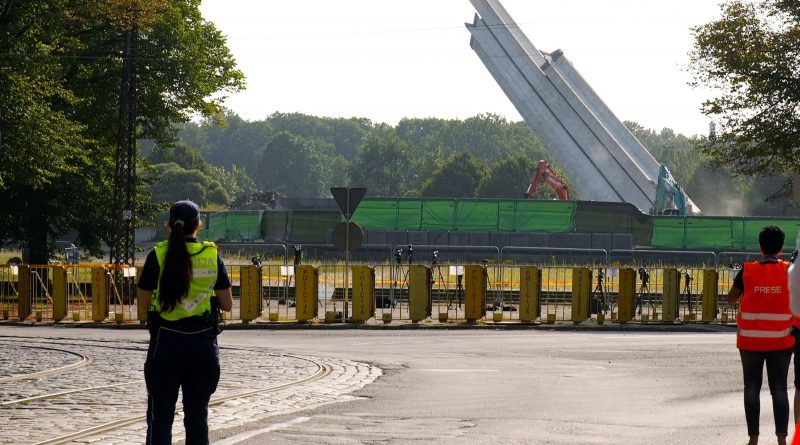
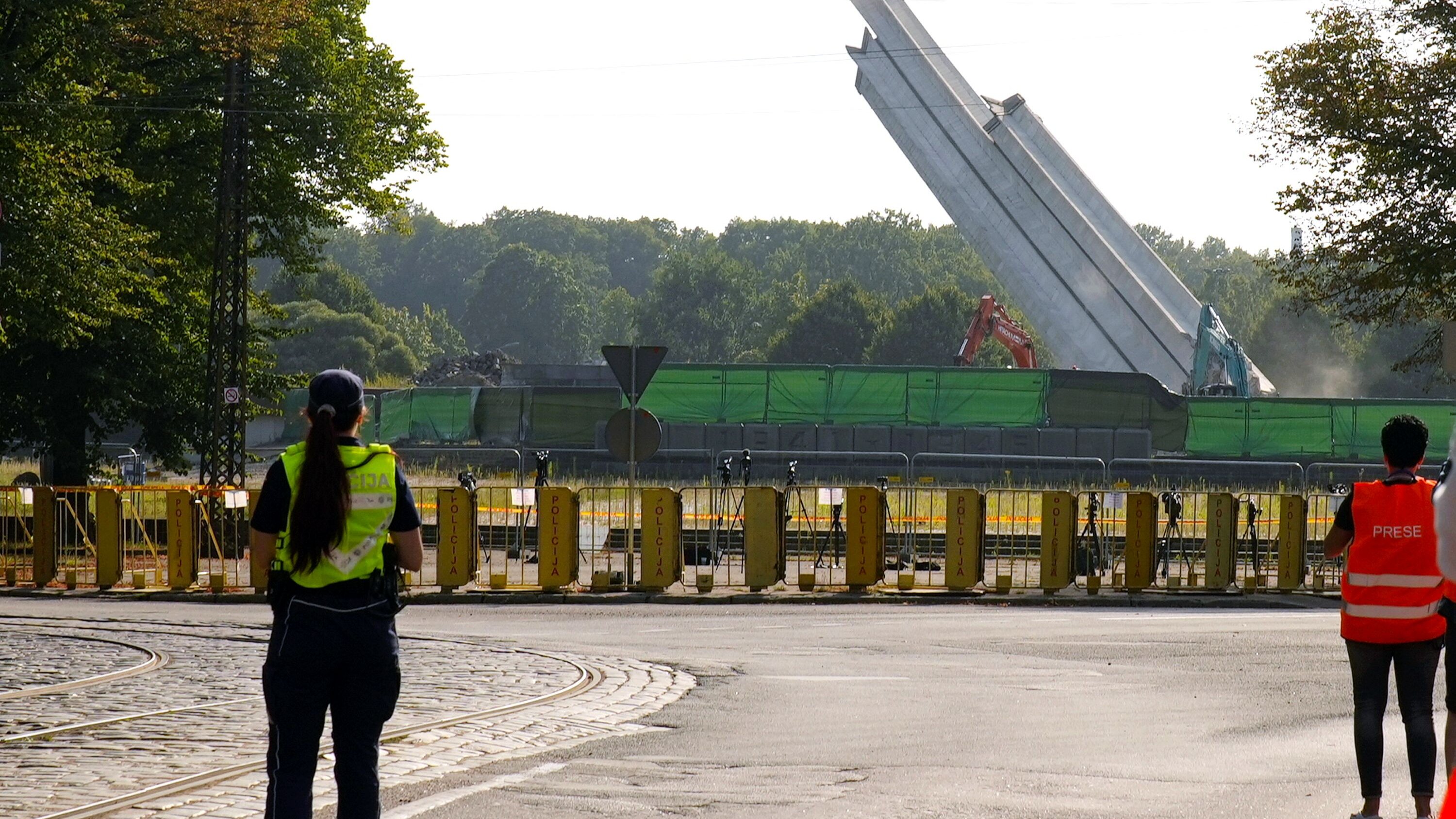
The nearly 260-foot tall obelisk, erected during the Soviet rule of Latvia, had towered in a park in the Baltic nation’s capital for nearly four decades.
This week, it came tumbling down as part of a broader government effort to show solidarity with Ukraine and to remove symbols of what many Latvians consider to be a traumatic chapter of the country’s history.
Featuring five spires and five-pointed stars, the monument was built in 1985 in Latvia’s capital, Riga, as a memorial to Soviet soldiers killed in World War II. Latvia was occupied by Nazi Germany in 1941, inaugurating the mass killing of Jews, Roma and those the Nazis deemed politically objectionable. Soviet forces ousted the Nazis in 1944, and Latvia remained under Soviet rule until regaining its independence in 1991 as the Soviet Union dissolved.
About one-third of Latvia’s two million residents speak only or primarily Russian. Many arrived during the decades of Soviet rule, or are their descendants. In those years, tens of thousands of Latvians fled the country or were deported, and Moscow sent an equal number of Russians into Latvia. Such a large Russian-identified minority has caused fissures within the country. In recent years, the Latvian government has sought to limit the proliferation of Russian in Latvia by, among other things, limiting Russian language instruction in the country’s schools.
Russian speakers have gathered over the years at the obelisk each May 9 to commemorate the Soviet ouster of Nazi rule, making it a contentious spot in the city.
Officials in Riga approved the demolition of the obelisk in May, after the Latvian Parliament voted to remove it.
On Wednesday, the Riga City Council noted that the monument had become “an ideologically charged symbol of the totalitarian regime of the Soviet Union and the Soviet army.”
“At a time when Russia, as the heir of the Soviet Union, is committing crimes against humanity in Ukraine, the existence of the monument risks polarizing society,” it said in a statement, adding that Latvia would not allow symbols that “justify and glorify aggression.”
On Thursday, images of the monument collapsing from its base into a surrounding pool were shared by local media and applauded by Latvian officials.
“Closing another painful page of the history and looking for better future,” said Edgars Rinkevics, the nation’s foreign minister, in a tweet that shared video of the monument toppling.
“The time has come to complete de-communization throughout Europe and finally free ourselves from the Soviet totalitarian past,” Olena Kondratiuk, the deputy speaker of Ukraine’s Parliament, wrote on Telegram.
The Kremlin has accused European countries of rewriting history and disregarding Russia’s role during World War II, and a Russian official called the demolition of the monument an affront to Soviet soldiers.
The events in Riga “cannot cause anything but a feeling of deep outrage, because a monument to the warriors who liberated Riga was destroyed there,” said Mikhail Shvydkoy, a Russian presidential envoy for international cultural cooperation, according to Russia’s Interfax news agency on Wednesday.
Latvia is not alone in seeking to dismantle symbols of the Soviet era: Other nations critical of Russia’s invasion of Ukraine, including Poland, have said they will do the same. Estonia recently removed a Soviet-era tank from a World War II memorial, prompting a wave of cyberattacks from a Russian hacking group.
Anton Troianovski contributed reporting.
Energy prices paid by most British households are set to rise 80 percent this fall, the latest economic blow to European consumers and businesses as the war in Ukraine stretches already tight markets for energy.
The news of the price increases from Britain’s energy regulator, Ofgem, came during a moment of deep political drift in Britain, with Prime Minister Boris Johnson preparing to leave office and his Conservative Party preoccupied by a contest to replace him. Mr. Johnson has left it for his successor to craft a response to the skyrocketing energy costs.
The front-runner to replace Mr. Johnson, Liz Truss, has promised targeted aid to help those hardest hit by higher bills, though she has steadfastly refused to detail her plans. She and her opponent, Rishi Sunak, both reject more sweeping measures, like using state subsidies to freeze the energy price cap for two years.
Ms. Truss, writing in The Daily Mail on Friday, said, “I know how hard it is for millions of Britons, and how grave concerns are about the consequences of today’s decision by Ofgem on the next energy price cap. The rest of Europe is facing the same challenge, which will loom large as winter sets in.”
The price hikes and how to deal with them have become a hot subject of political discourse in Britain and across Europe.
In the six months since Russia invaded, the state media’s emphasis in reporting the war has gradually shifted. Gone are predictions of a lightning offensive that would obliterate Ukraine. There is less talk of being embraced as liberators who must “denazify” and demilitarize Ukraine, though the “fascist” label is still flung about with abandon.
Instead, in the Kremlin version — the only one most Russians see, with all others outlawed — the battlefields of Ukraine are one facet of a wider civilizational war being waged against Russia.
The reporting is less about Ukraine than “about opposing Western plans to get control of Mother Russia,” said Stanislav Kucher, a veteran Russian television host now consulting on a project to get Russians better access to banned news outlets.
On state media, Russia is a pillar of traditional values, bound to prevail over the moral swamp that is the West. But the extent of Russia’s staggering casualties in Ukraine remains veiled; only the Ukrainian military suffers extensive losses.
State television has played down the mounting Ukrainian attacks on the strategically and symbolically important Crimean peninsula, but the images on social media of antiaircraft fire erupting over Crimea began to put domestic political pressure on the Kremlin.
The visceral reality of the war, especially the fact that Russian-claimed territory was not immune, was brought home both by the strikes on Crimea and by what investigators called a premeditated assassination in Moscow.
Daria Dugina, 29, the daughter of a famous nationalist and herself a hawk, was killed by a car bomb late Saturday, with official news outlets blaming Ukraine and its Western backers.
Glimpses of the war’s cost, however, remain the exception, as news and talk shows have branched into myriad economic and social topics to try to hammer home the idea that Russia is locked in a broad conflict with the West.
Lev Gudkov, the research director at the Levada Center, an independent polling organization, said the government explains European and American hostility by saying that “Russia is getting stronger and that is why the West is trying to get in Russia’s way,” part of a general rhetorical line he described as “blatant lies and demagogy.”
As state television stokes confrontation, the talk show warriors are getting “angrier and more aggressive,” said Ilya Shepelin, who broadcasts a Russian press review on YouTube for the opposition organization founded by the imprisoned Kremlin critic Aleksei A. Navalny.
The warning by a top U.S. official this week that Russia is preparing to stage “sham” referendums in Russian-occupied parts of Ukraine has brought back bad memories of similar episodes from the country’s recent history.
Despite widespread international condemnation, Moscow and its proxies orchestrated two sets of referendums in Ukraine in 2014: first in Russian-annexed Crimea, and then months later in parts of the eastern Donbas region controlled by Kremlin-backed separatist forces.
Now, Washington is warning that history is likely to repeat itself. “We expect Russia to try to manipulate the results of these referenda under the false claim of the Ukrainian people wanting to join Russia,” John F. Kirby, the National Security Council spokesman, told reporters on Wednesday, adding that votes could take place as early as this weekend.
For months, Russia has been laying the groundwork to hold referendums in the territories it has captured, part of a strategy to provide a veneer of legitimacy as it moves to annex those parts of the country.
The Russian curriculum is being taught in schools. Ukrainians are being encouraged to apply for Russian passports to access state benefits. The Russian authorities have even rerouted mobile phone and internet connections through Russia’s censored networks and, in some areas, blocked access to Facebook, Instagram and Twitter, as well as to Ukrainian news websites and other independent sources of information.
“One trick we can expect Russia to repeat is holding a referendum which doesn’t actually give voters any choice,” said Keir Giles, a Russia expert at Chatham House, a London-based research institute. “In 2014, people in Crimea voting at gunpoint had two choices on the ballot slip; neither of them was returning to being governed by Ukraine.”
However, in contrast to the Crimea referendums in 2014, when international condemnation was strong, Mr. Giles said some European leaders may be less vocal now in their criticism of potential referendums, however dubious they may be, if the entrenchment of Russian control curbs the fighting and lessens the global economic impact of the war.
The U.S. intelligence assessment that referendums could be held as soon as this weekend has led many observers in Ukraine, Washington and Brussels to suspect that Russia is attempting to create a bulwark against a long-expected Ukrainian counteroffensive by annexing territory and solidifying Russian control on the ground.
However, some experts stressed that the referendums would do little to alter the war’s dynamics or to change the hearts and minds of Ukrainians in areas loyal to Kyiv.
“The referendums will have no influence on the battlefield,” said Oleg Ignatov, senior Russia analyst at the International Crisis Group, a Brussels-based think tank. “If anyone thinks that these referendums will allow them to hold onto these occupied territories, it is very naïve.”
Mr. Ignatov added that any referendum that leads to the annexation of Ukrainian territories would push Kyiv away from the negotiating table, depriving Moscow of an “exit strategy” and locking it into a protracted conflict.
In August, President Volodymyr Zelensky of Ukraine warned that any Russian-orchestrated referendum in occupied areas of his country would end all chances of peace talks with Ukraine.
Mr. Ignatov said that any new referendums in occupied territories in Ukraine would not be credible given that hundreds of thousands of Ukrainians have already fled the occupied regions and would not be able to vote.
“It is nonsense,” he said. “We will not be able to believe any results from these referendums.”
Cluster munitions have killed at least 689 people in Ukraine in the six months since Russia invaded the country, the Cluster Munition Coalition, an international disarmament group, said in its annual report on Thursday.
Cluster munitions include bombs, missiles, rockets, mortar and artillery shells that open midair to dispense smaller weapons or bomblets over a large area that are designed to detonate on impact. Civilians can be easily caught in their path.
And the many bomblets that do not detonate are still volatile, and can explode later if they are picked up or handled. In 2021, the Cluster Munition Coalition documented incidents in Laos and Lebanon in which groups of children were injured or killed from playing with remnants of cluster munitions.
The researchers could not establish whether all of the nearly 700 people killed by the munitions were civilians, as the status of some had not been reported, but said that it was clear that the vast majority were not combatants.
“The civilian harm from the use of cluster munitions in Ukraine is a devastating development that overshadows this year’s report,” Mary Wareham, the arms advocacy director at Human Rights Watch and editor of the report, said in a phone interview. Human Rights Watch chairs the Cluster Munition Coalition.
More than 100 countries, including most of NATO’s member states, agreed to ban the weapons in the Convention on Cluster Munitions, which took effect in 2010. However, Russia, Ukraine and the United States are not signatories.
Ukraine is the only country where cluster munitions are currently being used, the report said. Both sides in the current war have been documented using the weapons, but Russian troops have used them far more extensively.
Hundreds of Russian attacks with cluster munitions have been documented, reported or alleged in 10 of Ukraine’s official regions, according to the new report, while Ukrainian forces have used them at least three times. Russia has used both old stores of cluster munitions and at least two types of newly developed varieties, the report said.
Throughout the war, Russia has shown its willingness to strike civilian targets, including theaters, hospitals and apartment buildings. On Monday, the United Nations reported that it had confirmed the deaths of 5,587 Ukrainian civilians. The true number is thought to be in the tens of thousands.
Human Rights Watch released an investigation last week that found that, in May and June alone, Russian forces launched cluster munitions in Kharkiv that struck homes, city streets, parks, a cultural center and an outpatient clinic at a maternity hospital.
In a statement about the new report, Jeff Meer, the U.S. executive director of Humanity & Inclusion, an independent aid organization, said, “We know two things for sure about cluster munitions: they are indiscriminate weapons, and 98 percent of causalities are civilians.”
WASHINGTON — The U.S. State Department and Yale University researchers said Thursday that they had identified at least 21 sites in the Donetsk region of eastern Ukraine that the Russian military or Russian-backed Ukrainian separatists are using to detain, interrogate or deport civilians and prisoners of war in ways that violate international humanitarian law. There were signs pointing to possible mass graves in some areas, they said.
Researchers at the Yale School of Public Health’s Humanitarian Research Lab said the sites were part of a “filtration system” used for processing detainees and prisoners. They reached their conclusions after examining commercial satellite imagery and open-source information. The detainees and prisoners could be forced to live outside the centers in Russian-occupied areas of Ukraine, imprisoned for long periods, deported to Russia or even killed.
The research was a collaboration between Yale and the Conflict Observatory program that the State Department set up in May to document war crimes and other atrocities committed by Russian or Russian-backed forces in the Ukraine war. The researchers released their findings through a report from Conflict Observatory.
“We again call on Russia to immediately halt its filtration operations and forced deportations and to provide outside independent observers access to identified facilities and forced deportation relocation areas within Russia-controlled areas of Ukraine and inside Russia itself,” the State Department said in a statement referring to the new findings.
The report identified four types of centers in the filtration system: registration, holding, secondary interrogation and detention.
The researchers also found evidence of disturbed earth on two recent occasions at the Volnovakha “correctional colony” near the village of Olenivka that they said was consistent with mass graves. The appearance of disturbed earth predated an explosion on July 29 at the prison compound that killed 53 Ukrainian prisoners of war.
One area of disturbed earth appeared in imagery from April 11 — “contemporaneous with an open source account of alleged gravedigging,” the report said, referring to an online account in which a former inmate discussed a cellmate working a shift digging graves. A second area of disturbed earth appeared on July 27, two days before the explosion.
A New York Times analysis from early August of images from Maxar Technologies and Planet Labs, two satellite imaging companies, concluded that some time after July 18 and before July 21, about 15 to 20 spots of notable changes to the ground appeared on the southern side of the complex. They were about 6 to 7 feet wide and 10 to 16 feet long at first, and some later appeared to have been lengthened to merge. It was unclear whether they were grave sites.
The Conflict Observatory report said the Volnovakha center was being used as a long-term detention center for civilians being kept under the auspices of “administrative detention” and for holding prisoners of war, particularly Ukrainians who surrendered after the siege of Azovstal, in the coastal city of Mariupol. “Filtration” activities appear to have begun there in late March and have continued since then.
The researchers noted that there had been reports of torture, beatings, lack of water and proper nutrition, unhygienic conditions and overcrowded cells at the compound.
The State Department said it was giving an additional $9 million to the Conflict Observatory through the European Democratic Resilience Initiative.
“This focus on accountability lays the foundation for future civil and criminal legal processes, whether in Ukraine, through international mechanisms, or in third-party countries that have established jurisdiction,” it said.
“President Putin and his government will not be able to engage in these persistent abuses with impunity,” the department added. “Accountability is imperative, and the United States and our partners will not be silent.”
In June, the U.S. National Intelligence Council released an unclassified report that said it had identified 18 possible locations in Russian-occupied eastern Ukraine and western Russia where detainees and prisoners were being held and processed.
Powered by WPeMatico