
Army’s planned detonation in Iowa raises concerns over lead exposure
Residents in parts of southeastern Iowa and northwest Illinois are being warned about possible lead dust exposure as the U.S. Army prepares to detonate 68 barrels of lead azide that have been stored for more than 20 years at the Iowa Army Ammunition Plant.
The barrels cannot be safely transported because the lead azide had become drier and more volatile than expected, according to Justine Barati, deputy chief of public and congressional affairs for Army Sustainment Command. The aging explosive can detonate from movement, friction or other disturbances, and Army officials determined that an on-site detonation was the safest disposal option.
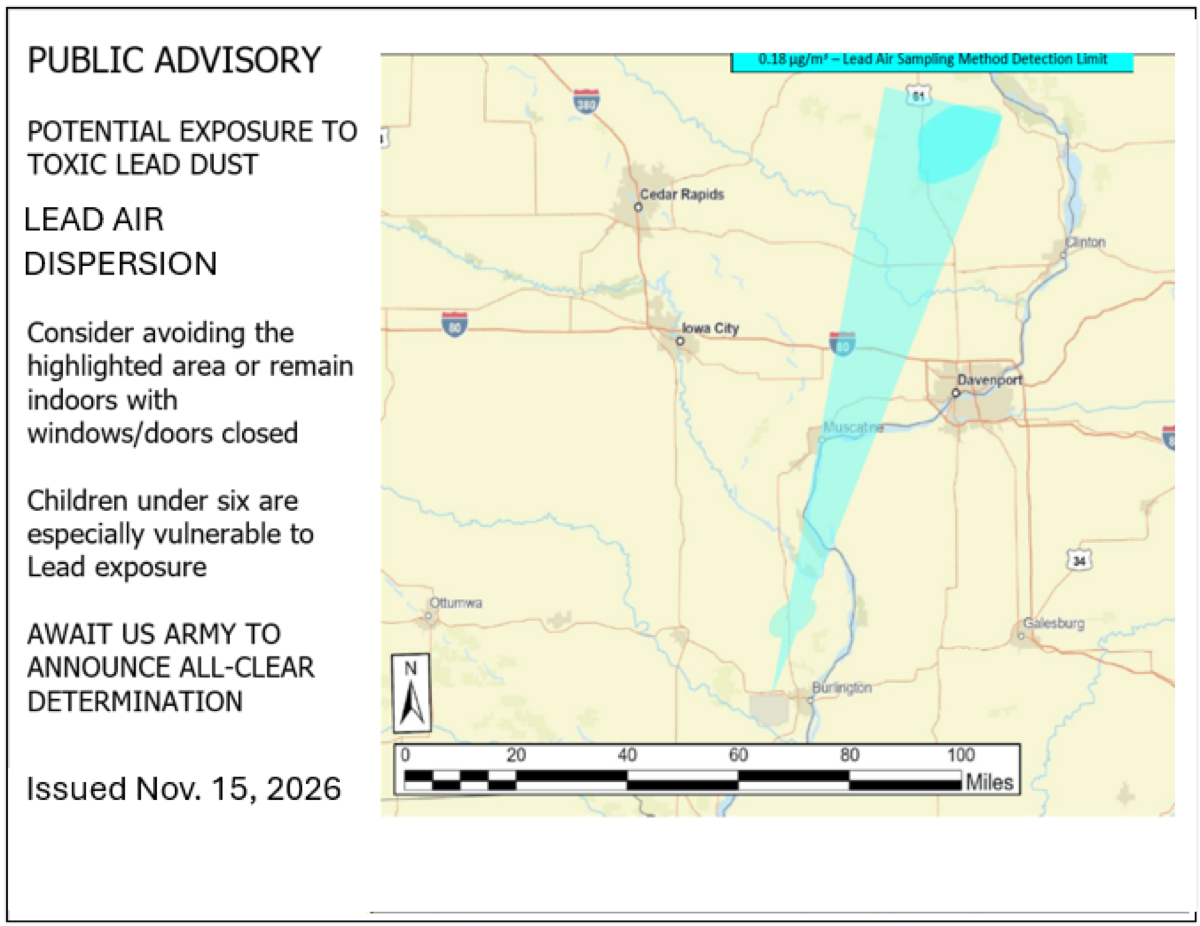
The detonation, scheduled for Nov. 20, is expected to generate two rapid explosions and ground vibrations that could potentially damage windows, according to an Army public advisory. Army air-dispersion modeling showed a potential airborne lead plume extending close to 100 miles from the Iowa Army Ammunition Plant.
Officials have advised residents within the projected impact area to evacuate beforehand if possible or remain indoors with windows closed and ventilation systems set to recirculate air.
The Army and U.S. Environmental Protection Agency say air sampling, environmental monitoring and post-detonation cleanup efforts are planned. Officials have maintained that the blast should result in temporary and limited environmental impacts.
But the operation has raised concerns among health and environmental experts, who question whether the Army has released enough information about potential lead exposure.
The Iowa Army Ammunition Plant is located near Middletown, a small town in southeastern Iowa’s Des Moines County near the Illinois border.
Potential lead exposure risks
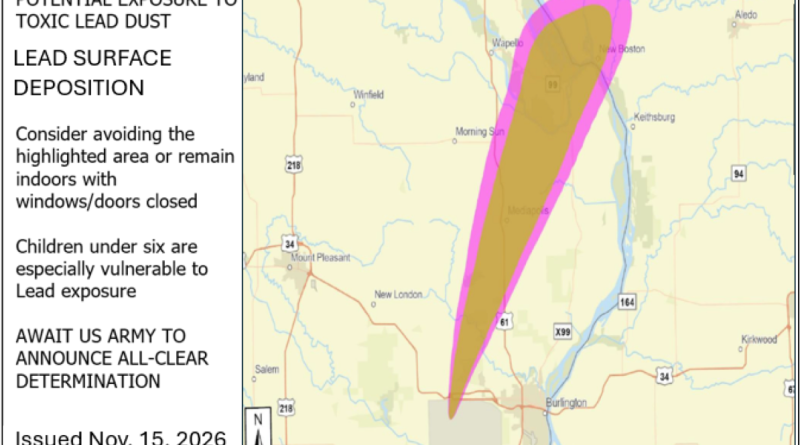
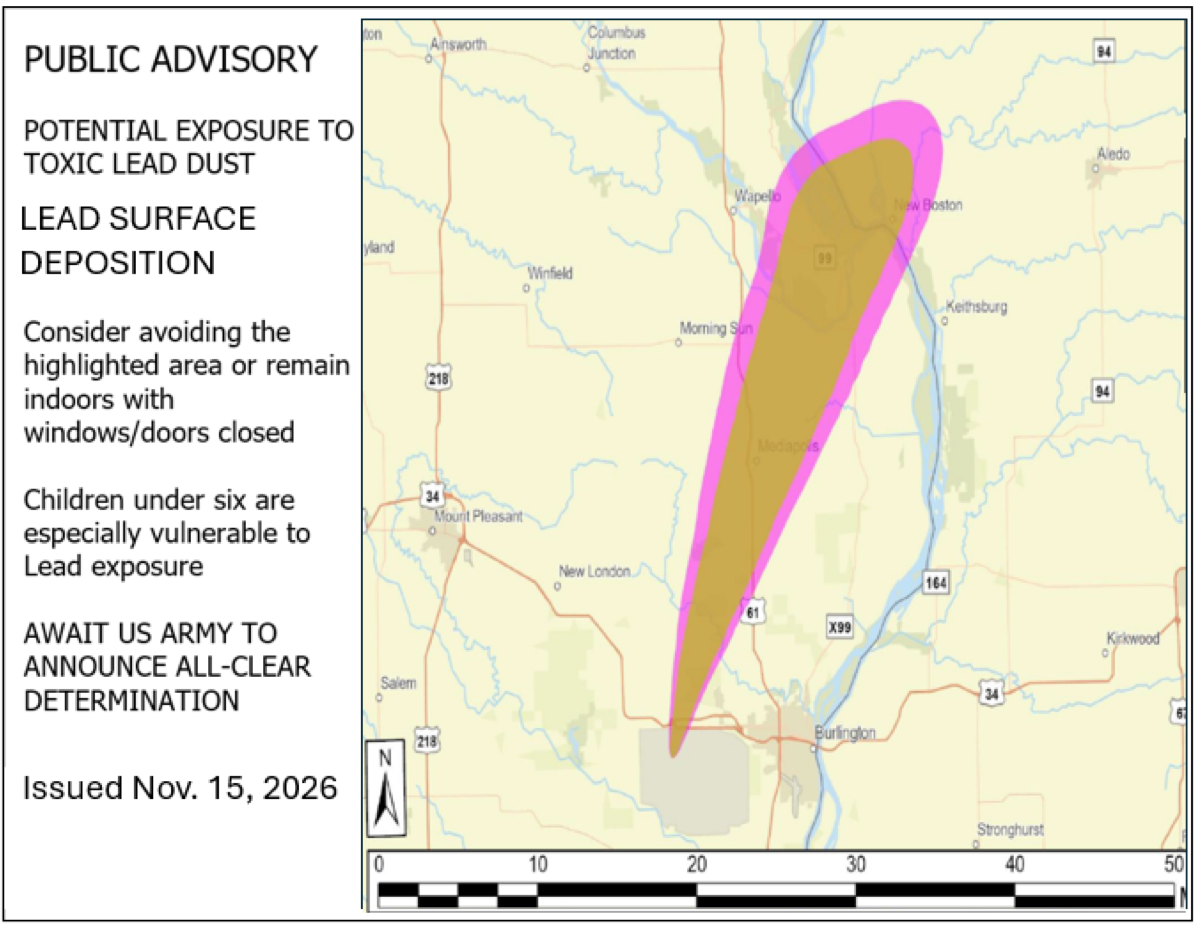
The Army has released plume maps showing where lead particles could travel after the blast, raising concerns among residents and health experts. Depending on weather conditions, the plume could extend across portions of southeastern Iowa and northwest Illinois.
Jennifer Sample, a medical toxicologist, told the USA TODAY Network’s Des Moines Register that lead remains particularly dangerous for young children because it can cause irreversible neurological damage. While some schools have already canceled classes on Nov. 20 in anticipation of the detonation, Sample said “the state of Iowa should close all schools in the plume path.”
A brief exposure to low concentrations is not the same as months or years of exposure and does not necessarily result in lead poisoning. However, health experts note that there is no scientifically established threshold below which lead exposure is entirely risk-free.
According to the Centers for Disease Control and Prevention, no safe blood lead level has been identified in children. Even low levels of exposure can affect learning, attention and academic performance.
Experts also warn that lead can accumulate in adults’ bones over time. During pregnancy and breastfeeding, lead can be released along with calcium and pass to the fetus or infant.
How to protect yourself from lead exposure
In its public safety advisory, the Army warned that exposure could occur through inhalation of airborne lead particles or contact with lead dust that settles on surfaces. Officials recommend that people in potentially affected areas:
- Remain indoors during the potential exposure period if they cannot evacuate beforehand.
- Close all windows, exterior doors, and other openings during the exposure period.
- Turn off or place heating, ventilation, and air conditioning (HVAC) systems in recirculation mode, minimize outdoor air intake, and maximize indoor air filtration during the potential exposure period.
- Avoid traveling through the affected area during the potential exposure period.
- Wet-clean surfaces that may be contacted by children, including outdoor play equipment, toys, tables and chairs, handrails, patios, decks, exterior windowsills and other high-contact surfaces.
Pet owners should take precautions as well. Sample said dogs allowed outside could carry lead dust back into homes and should be washed before returning indoors. She also said wildlife could be exposed to lead particles and absorb lead into their bodies.
Independent researchers express skepticism
While Army officials said the environmental impacts should be minor and short-term, some independent researchers remain skeptical. Drew Latta, director of Iowa’s “Get the Lead Out” program, said information about the detonation should have been released to the public sooner.
“It just seems like there’s a lot of unease. And if they’ve got evidence that can cause that unease to go away, they need to do better at communicating it. And quickly,” Latta told the Register.
David Cwiertny, director of the Center for Health Effects of Environmental Contamination at the University of Iowa, also expressed reservations about the Army’s cleanup plans, writing on social media that hosing down lead-containing dust does not mean it is “magically gone.”
Latta and Cwiertny have been working together to conduct independent monitoring research of the detonation.
US Army says detonation is safest option
Lead azide is a primary explosive used to initiate munitions, according to a Q&A sheet from the plant. The barrels had been moved to the Iowa Army Ammunition Plant for use in munitions production but were not all used, Barati said.
The material was later designated hazardous waste, and the facility shut down for two weeks in March to conduct a safety review out of an abundance of caution. Army officials say leaving the material in storage presents growing risks, particularly during colder weather.
“It’s the Army trying to do the best and safest thing for the public, because we are concerned that as the weather gets colder, lead azide becomes more volatile — and it could self detonate,” Barati told the Register.
Responding to concerns about lead contamination, Barati said projected exposures would be minimal and temporary. She also confirmed there are no plans to offer lead blood testing related to the detonation.
“It’s not lead paint where it’s a chronic exposure by children,” she said. “It’s the equivalent of living in a mining town for one hour.”
Residents whose property is damaged by the blast may submit claims to the Army, and some property owners may be asked to allow environmental sampling on their land.
This article originally appeared on USA TODAY: Army’s planned detonation in Iowa raises concerns over lead exposure
This article originally appeared on USA TODAY at https://www.usatoday.com/story/news/nation/2026/11/18/iowa-army-ammunition-plant-lead-azide-detonation/92852446007/
Powered by WPeMatico