
Alberta Premier Danielle Smith changing sovereignty bill after ‘confusion’ over powers given to cabinet
:format(webp)/cloudfront-us-east-1.images.arcpublishing.com/tgam/6UCHURQ43ZJA5PRMMNIKYUXXDQ.jpg)
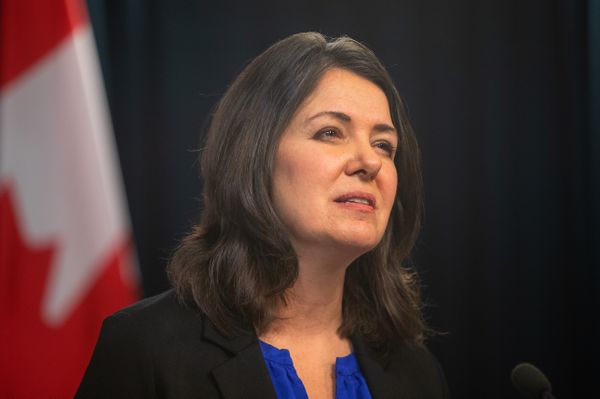
Alberta Premier Danielle Smith’s sovereignty bill was a central part of her platform when she ran for the United Conservative Party leadership.JASON FRANSON/The Canadian Press
Alberta Premier Danielle Smith says she’ll change language in her government’s proposed sovereignty act that allows executive members to unilaterally change statutory law, a provision that drew criticism after the bill’s introduction into legislature this week.
The Premier said Saturday that there was “confusion” over wording in the Alberta Sovereignty within a United Canada Act that made it possible for cabinet to change law without getting approval from legislature first. She said that kind of executive power was not intended.
“You never get things 100-per-cent right all the time,” said Ms. Smith, speaking on the Global News radio show, Your Province, Your Premier.
“If there’s any changes to statutes, it does have to come back to the legislature, so we’re working on making sure that that gets clarified.”
The act, tabled as Bill 1, was a central part of Ms. Smith’s platform when she ran for the United Conservative Party leadership. It seeks to give the Alberta government more autonomy in the face of federal laws that it believes are overreaching, though critics of the bill have questioned its constitutionality.
Kelly Cryderman: Danielle Smith’s sovereignty act faces unexpected in-house criticism
Andrew Coyne: At some point, Ottawa is going to need to engage in firm-handed federalism
While Ms. Smith said the legislation was never meant to give cabinet unilateral powers, Minister of Justice and Attorney-General Tyler Shandro had confirmed during a news conference earlier this week that Bill 1 would allow cabinet to amend laws through orders in council.
When asked if the bill would give cabinet members unilateral power to change laws, he answered that “that is correct.”
During her radio interview, the Premier characterized the change as part of the standard procedure of amending bills as the move through legislature.
“It’s part of the process that you go through with bills, you introduce them, you debate whether there’s possible amendments and then you pass them through,” Ms. Smith said.
“If we caused some confusion with some awkward wording, then let’s clean it up and then be able to talk about the bigger issues.”
Eric Adams, a law professor with the University of Alberta, said the reversal represents a notable shift in what was a headline policy for the Premier.
“It’s a major pivot, there’s no question about that,” said Mr. Adams. “It raises questions of how well this signature piece of legislature was understood at the outset, how carefully it was drafted and how much thought and good governance planning went into its architecture.”
Mr. Adams said it was surprising that there was a mechanism to give such sweeping powers to the executive branch in the first place, and that Saturday’s turnabout will shake people’s confidence into the planning of the bill.
However, he said the fundamentals of the act will remain the same, and only the mechanism of how its powers are implemented is changing.
Mr. Adams added that the amendment will be a step in the right direction, but constitutional challenges can still be made around the bill.
“It’s a positive development for the democratic credentials of the proposal … but I don’t think this change sweeps away the likelihood that the act faces serious constitutional challenges. It does reduce one of its major lines of exposure.”
Bill 1, now in second reading, has also triggered concerns over the provision that grants cabinet the power to order provincially legislated or funded entities to reject federal laws, if the executive deems Ottawa to be causing harm to the interests of Albertans. Those entities include municipalities, police forces, health regions, postsecondary institutions and school boards.
During a Friday interview on CBC News Network, Calgary Mayor Jyoti Gondek said the provision directing municipalities to rebuff federal laws is “a dangerous scenario” for municipalities that rely on funding from both the province and Ottawa.
“If they direct us in a manner – let’s use an example – that says you can’t accept any federal funding directly, what does that do to our affordable housing strategy?” Ms. Gondek said.
“No matter how you slice this, it’s going to be really tough for municipalities to actually govern and serve their people.”
With a report from The Canadian Press
Powered by WPeMatico