
B.C. firefighters battling two aggressive and fast-spreading wildfires
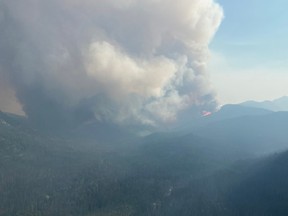
An evacuation alert has been issued for a new wildfire that broke out Friday west of Princeton.

Article content
B.C. firefighters are battling two aggressive and fast-spreading wildfires, as hot, dry and windy conditions hamper containment efforts.
Advertisement 2
Story continues below
Article content
One is the Heather Lake wildfire that started in the U.S., in the Okanogan Wenatchee National Forest, according to the B.C. Wildfire Service.

Article content
That blaze, which is considered out of control, was discovered in the U.S. last month but officials said Saturday that it has now crossed the border and is quickly spreading into E. C. Manning Provincial Park. The fire is not threatening any homes, however it “is exhibiting aggressive fire behaviour and is highly visible from Highway 3,” fire officials said.
The fire is suspected to be caused by lightning and is estimated at 1,500 hectares in size.
Meantime, an evacuation alert was issued Friday for another wildfire in B.C.’s Interior. The alert was issued by the Penticton Indian Band for the Shingle Creek area due to the Blue Mountain Wildfire, which broke out Friday west of Penticton and quickly spread to 50 hectares, fanned by strong winds.
Advertisement 3
Story continues below
Article content
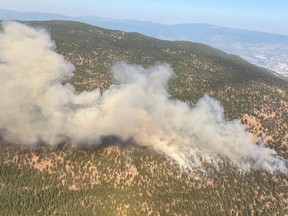
Elsewhere, firefighters say the Battleship Mountain wildfire, located about 50 kilometres west of Hudson’s Hope, is also spreading because of the hot and windy conditions.
That fire, which is a wildfire of note, is now estimated at 4,500 hectares. It is one of five wildfires of note in B.C. The others are the Bearhole Lake and Dinosaur Lake wildfires, both in the Prince George fire centre, and the Fat Dog Creek and Heather Lake blazes in the Coastal fire centre.
Bearhole Lake, which is also considered out of control, is mapped at 1,600 hectares and expected to grow because of the hot and windy conditions, according to the B.C. Wildfire Service.
Wildfire smoke from southern B.C. and Washington State are causing hazy skies and smoky conditions in many parts of the province.
Advertisement 4
Story continues below
Article content
On Saturday morning, Environment and Climate Change Canada posted air quality alerts for more than 20 regions, mainly in the Interior and northeast parts of the province, saying communities would likely be impacted by wildfire smoke over the next 24 to 48 hours.
On Thursday, Forests Minister Katrine Conroy said it has been a below-average wildfire season so far this year in British Columbia, but high fire risks are forecast for September.
She said the number of wildfires and the area they have burned since April both compare favourably with the 20-year average, with 1,355 fires charring 430 square kilometres this year.
That is only about one-sixth of the area burned by 1,515 fires to this date on average, and one-twentieth of the 8,650 square kilometres burned last year, when the province was scorched by the heat-dome weather event.
Neil McLoughlin, a B.C. Wildfire Service spokesman, says up to 75 per cent of B.C. wildfires were caused by lightning this season, with 98,000 strikes recorded in August.
He said s warm, dry weather is forecast to continue through September, which will keep fire risks high in the province’s southwest and northeast regions.
Advertisement 5
Story continues below
Article content
Advertisement 6
Story continues below
Article content
—with files from The Canadian Press
-

B.C. Wildfire Map 2022: Updates on fire locations, evacuation alerts/orders
-

B.C. wildfires scorch area well below average, but hot September poses threat

Powered by WPeMatico