
Live Updates: Sri Lanka’s President Flees, Deepening Leadership Crisis
COLOMBO, Sri Lanka — President Gotabaya Rajapaksa of Sri Lanka fled the country on Wednesday after months of demonstrations demanding that he leave office culminated with protesters storming his official residence.
Mr. Rajapaksa left on an Air Force plane to the Maldives at about 2 a.m. local time, said Colonel Nalin Herath, a spokesman for Sri Lanka’s defense ministry. Three immigration officials, who declined to be named given the political situation, confirmed his departure as well.
The island nation is experiencing the worst economic crisis in its history, exacerbated by government mismanagement and missteps. Protests over a severe shortage of food, medicine and fuel have lasted for months.
Mr. Rajapaksa went into hiding after protesters took over his office and residence. He had told allies he was resigning on Wednesday.
The country’s prime minister, Ranil Wickremesinghe, had on Saturday suggested he would also step down, but he appeared to be staying on. Protesters had been demanding his resignation as well.
As Mr. Rajapaksa’s departure from the country was confirmed, Mahinda Yapa Abeywardena, the speaker of the Parliament, said in a phone interview that he still had not received the president’s letter of resignation, which would make the end of his presidency official.
Mr. Rajapaksa, 73, a career military officer, would be the last member of his family’s dynasty to leave government. In May, Mahinda Rajapaksa, the prime minister and the president’s elder brother, was forced from office by protests. The finance minister, Basil Rajapaksa, another brother, and several other members of the family were also removed from their posts.
The fuel shortage has upended daily life in Sri Lanka for months, with the country essentially bankrupt and out of foreign-currency reserves for essential imports. The prices of food and medicine have soared, power cuts have become the norm and public transportation is often suspended to shore up fuel supplies.
The transition to a new government now puts the spotlight on a Parliament that has long frustrated the island nation of 22 million, with lawmakers and political parties engaging in protracted and messy fights over positions of power. Complicating matters, the ruling party loyal to the Rajapaksas still maintains a majority of the seats.
Sri Lanka’s constitution is clear on succession. In the event of that a president resigns, the prime minister takes on his duties in an interim capacity. The proceedings then turn to Parliament, where lawmakers vote for a new president from their midst to complete the term. Mr. Rajapaksa’s term had two years to go.
Still, the nation’s political leaders remain unpopular and many are associated with the Rajapaksa family. Protesters have been adamant that a new leader must be appointed who is free of those ties. On Wednesday morning, as demonstrators processed the president’s departure, it was unclear whether that would be enough to end months of protests.
COLOMBO, Sri Lanka — Hundreds of protesters marched past the office of Prime Minister Ranil Wickremesinghe on Wednesday morning to demand that he step down, after demonstrations were reinforced overnight by throngs of people arriving in the capital, Colombo, from across Sri Lanka.
“We don’t want the robber Ranil, the bank thief, the deal thief!” the crowd chanted. The marchers included families with young children, many having set off from the president’s office.
Near the prime minister’s office, security forces fired tear gas in an attempt to disperse the protesters, but they would not budge and converged with another group. Riot police officers, along with air force and army forces, many wearing gas masks and holding rifles, stood nearby without engaging with the crowd.
Earlier in the day, outside the president’s office, the atmosphere was generally peaceful, with an air of celebration. People were digesting the news that President Gotabaya Rajapaksa had fled to neighboring Maldives.
“The thieves are running away,” said Sanjayra Perera, a university librarian who was among the thousands who had traveled to Colombo. She had brought her two children, 12 and 10, on Wednesday morning by train from the western city of Gampaha.
She said she wanted her family to be in the capital when the Rajapaksa family dynasty fell.
“This is our country,” she said. “We win.”
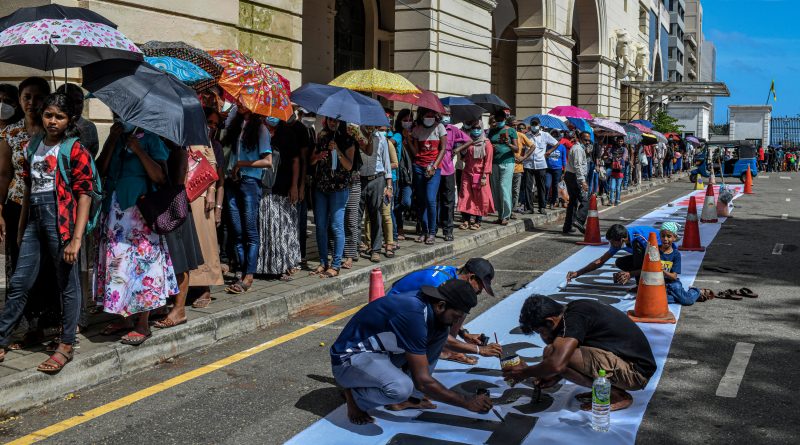
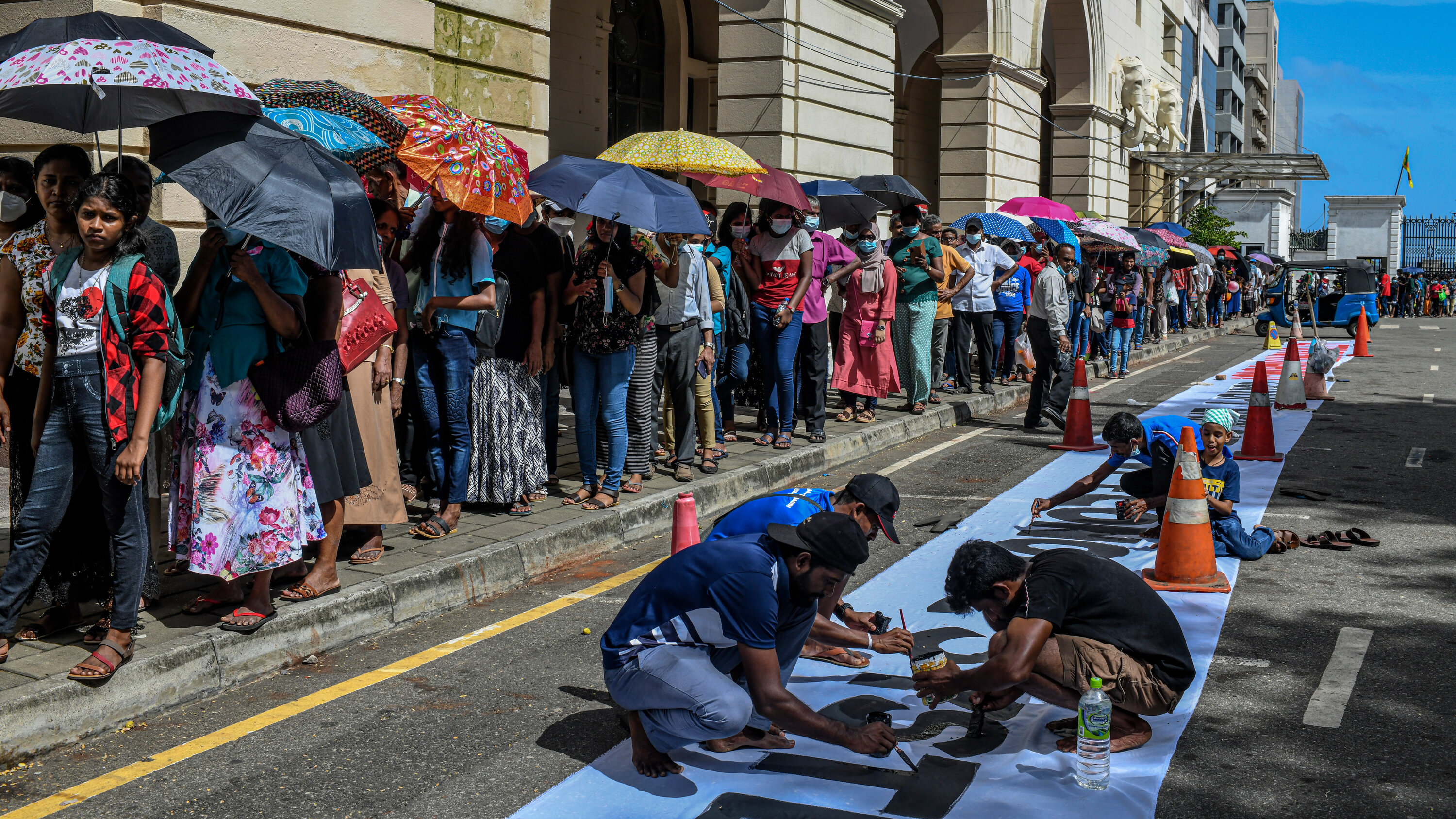
The crowd found patches of shade under statues, sat on the wall of an oceanfront park and waited in line, holding umbrellas to block the sun, for a chance to see the historic office building, one of three government buildings that protesters had taken over this past weekend.
Despite the uncertainty over whether Mr. Rajapaksa would resign on Wednesday, as the speaker of Parliament has said he would, and who might replace him, protesters were jubilant with the confidence that the end of an era was near.
“This is a historical day for us,” said Randika Sandaruwan, 26, who took the train on Tuesday night with nine friends from the nearby city of Negombo. “We needed to kick out our president, and now Gota is gone,” he said, using a nickname for the president.
Mr. Sandaruwan and his friends, like many protesters, had nothing to protect them from the tear gas.
Shameen Opanayake, 22, sat on the front steps with his mother and two sisters. They had taken an early bus from their home in Kalutara, south of the capital.
“If he doesn’t step down today,” he said, referring to the president, “I don’t think so that this place will remain calm. The whole country is rejecting him.”
Sri Lanka, an island nation of 22 million people, was once held up as an economic success story, with a rising middle class and one of the highest median income’s in South Asia. But the country is now essentially out of money and many people are living on the edge, the result of poor political decisions and economic mismanagement.
As food and fuel have run low in recent months, a swelling protest movement has pushed for the resignation of President Gotabaya Rajapaksa and other politicians tied to his family’s political dynasty. The situation came to a head this weekend when protesters breached the president’s residence.
Here’s how this crisis has developed:
-
The country is hit by a series of economic headwinds in early 2020, including the pandemic, which all but destroyed the tourism industry.
-
Officials ban fertilizers the next year, battering harvests and leading to fears of food shortages. While the misguided policy is lifted after seven months, the damage is already done.
-
As the country starts running out of foreign currency, supplies of food, fuel and other supplies dwindle, bringing protesters to the street. In May, the prime minister is forced out.
-
On Saturday, protesters take over the president’s residential in Columbo, as Mr. Rajapaksa went into hiding. The speaker of Parliament said the president has agreed to resign, as has the prime minister.
-
The president flees the country on Wednesday, leaving the leadership of the country uncertain.
One of the first signs of trouble came just before the coronavirus pandemic hit.
The newly elected president of Sri Lanka, Gotabaya Rajapaksa, fulfilled a campaign promise and enacted sweeping tax cuts in November 2019. The move would stimulate the local economy, said Mr. Rajapaksa, a member of a family that has dominated the country’s politics in recent decades.
But that plan was ground to a halt by the virus. Travel restrictions and lockdowns were a body blow to Sri Lanka’s tourism-based economy. And, crucially, the country was deprived of the foreign currency that it uses to buy fuel.
Credit-ratings agencies were soon warning about Sri Lanka’s deteriorating ability to pay down its already high debt. But, as the strains from the tax cuts on government coffers intensified and the Sri Lankan rupee lost value, Mr. Rajapaksa was unbowed.
One of the president’s next moves, in 2021, was to ban foreign-made fertilizer. Mr. Rajapaksa argued that the policy — billed as a push toward organic farming — was better for human and environmental health. Critics pointed out that stopping those imports would help shore up the country’s foreign-exchange reserves.
The policy was disastrous: Farmers were ill prepared for the change, and crop yields plummeted. That led to soaring food prices, which were already rising because of the pandemic, and led to worries about shortages. The fertilizer ban was lifted before the end of the year, but the reversal was too late to save the next harvest.
Soon, for many Sri Lankans, food and fuel were either impossible to find or too expensive to buy. The country was moving from a debt crisis to an all-out economic collapse. Daily life was upended with rolling power cuts, people waiting in lines for hours to buy fuel and cooking gas, and abrupt halts to public transportation.
The downward spiral was hastened by the war in Ukraine, which compounded supply-chain problems across the globe. In April, the government suspended payments on its international debt.
By this time, demonstrations against the government had become an almost daily affair in the country. Protesters blamed Mr. Rajapaksa and his family for their strife and wanted them out of government.
But the crisis in Sri Lanka is far from over. More than a quarter of its nearly 22 million people are at risk of food shortages, the United Nations said last month. The country needs $6 billion through the end of the year to buy fuel and other essential goods, and it is not clear where that money might come from.
President Gotabaya Rajapaksa’s ousting, after months of protest against him and the powerful ruling dynasty, does not necessarily open an easy path for Sri Lanka out of its economic and political crisis.
The transition to a new government now puts the spotlight on a parliament that has long frustrated the island nation of 22 million, with lawmakers and political parties engaging in protracted and messy fights over positions of power. What complicates the process: The ruling party loyal to the Rajapaksas still maintain a majority of the seats.
Sri Lanka’s constitution is clear on the succession. In the event of the president resigning, the prime minister takes on his duties in an interim capacity. The proceedings then turn to the parliament, where lawmakers vote for a new president from their midst to complete the remaining two years of Mr. Rajapaksa’s term.
As Mr. Rajapaksa’s departure from the country was confirmed, Mahinda Yapa Abeywardena, the speaker of the parliament, said in a phone interview that he still had not received the president’s letter of resignation, which would make the end of his presidency official.
As protesters took over Colombo this week, even the basics of that transition have been uncertain because the prime minister, Ranil Wickremesinghe, also said he would resign after protesters stormed his offices and forced him into hiding. Mr. Wickremesinghe’s private residence was set ablaze in the middle of the night.
But since Mr. Wickremesinghe has not officially gone through with his resignation, he will most likely become acting president. Opposition lawmakers said the parliament would then convene on Friday, which will open the process for electing a new president which, technically, could be completed in a matter of a week.
But the jostling for that position will be complicated, and potentially protracted.
The party loyal to the Rajapaksas, known by its Sinhalese initials of SLPP, enjoys a majority. It is unclear whether their choice for the presidency would be acceptable to the protesters or the opposition.
The two other candidates, in addition to the whoever the SLPP puts forward, are expected to be the leader of the opposition, Sajith Premadasa, and the prime minister, Mr. Wickremesinghe.
Sri Lankans often point to the history between the two men as an indication of the infighting plaguing the political elite. Until three years ago, both were members of the same United National Party, but their disagreements on which one of them would contest against Mr. Rajapaksa in the 2019 presidential elections led to a bitter public split.
Sri Lanka’s president, Gotabaya Rajapaksa, has fled to the Maldives, whose leaders have close ties with the president and his family.
Mr. Rajapaksa left around 2 a.m. Sri Lankan time on an air force plane, said Col. Nalin Herath, a spokesman for Sri Lanka’s Defense Ministry, on Wednesday.
The president arrived in the Maldives in a small, two-engine military transport plane, an AN-32, after asking to be taken to the neighboring island nation, according to Group Capt. Gihan Seneviratne, a spokesman for Sri Lanka’s air force. The plane has returned to Sri Lanka, he said.
Mr. Rajapaksa was accompanied by the first lady, Ioma Rajapaksa, and two security guards, Capt. Seneviratne said. It was not known whether the Maldives was a transit point or their final destination.
In recent months, with the end of Mr. Rajapaksa’s rule seemingly imminent, the Maldives was repeatedly in the news in Sri Lanka as somewhere the Rajapaksa family, which has dominated Sri Lanka’s politics for much of the past two decades, might seek refuge.
Many leaders of the Maldives ruling party have spent time in exile in Sri Lanka. Mohamed Nasheed, the former Maldivian president and current speaker of the country’s parliament, used Colombo as a base during the years of his own exile. In recent months, he was in Sri Lanka to meet with the country’s leaders and offer help in shoring up international assistance.
Mr. Rajapaksa is a former American citizen who has said he gave up his U.S. passport to run for president of Sri Lanka in 2019. Members of his immediate family live in the United States.
Mujib Mashal contributed reporting.
Powered by WPeMatico