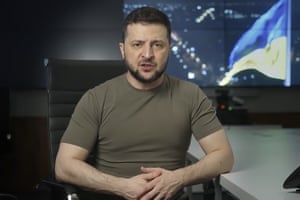
Volodymyr Zelenskiy warned his people early on Saturday that retreating Russian forces were creating “a complete disaster” outside the capital Kyiv by leaving mines across “the whole territory,” including around homes and corpses.
The Ukrainian president said Russian forces were withdrawing slowly but noticeably from around Kyiv and the northern city of Chernihiv.
Volodymyr Zelenskiy in his video address early on Saturday. Photograph: AP
But he warned: “They are mining the whole territory. They are mining homes, mining equipment, even the bodies of people who were killed. There are a lot of trip wires, a lot of other dangers.”
Ukraine’s military said it had retaken 29 settlements in the Kyiv and Chernihiv regions.
The Guardian has published some new reporting today on how the war is affecting food supplies, particularly the Middle East and North Africa.
The Russian invasion is leading to a dramatic decline in crops planted by farmers in the country this spring, with fears for domestic and international food security, writes Tom Levitt and Chris McCullough.
Known for its fertile soils, Ukraine is a major exporter of wheat, barley, sunflower and maize, in particular to north Africa. However, farmers and analysts have told the Guardian that planting, harvest and export have all been disrupted by a lack of fertiliser, low or no fuel supplies for tractors, closure of ports and military activity.
At least one-third of the land normally used for spring crops such as maize and sunflower is likely to go unplanted. Furthermore, one-third of the normal wheat harvest from the crop planted last autumn could be lost.
Read more here:
Meanwhile, the prices of basics such as oil and wheat are shooting up and shortages are showing on supermarket shelves in Lebanon, Somalia and Egypt, reports Lizzy Davies.
Lebanon, already mired in economic crisis and battling inflation before the war broke out in Ukraine, now finds itself grappling with even higher price rises for wheat and cooking oil.
Even before Russian tanks rolled into Ukraine on 24 February, Somalia had more than enough on its plate: the worst drought for four decades; hunger so widespread that famine could develop within months; a resurgence in violence by jihadi terrorists seeking to overthrow the fragile government.
Last year, Egypt imported more than 70% of its wheat from either Russia or Ukraine, according to the UN, so the first challenge for the state is to seek alternative suppliers away from the Black Sea.
Read more here:
At least 158 children have been killed and more than 254 injured in Ukraine since the beginning of the invasion, the country’s office of the prosecutor general has said.
The office said two of the fatalities were among 13 people killed when Russian forces fired at civilian cars on a highway in Chernihiv around 18 March.
In the message broadcast on Ukrainian government Telegram channels, the office said the numbers were not finalised as there were still active hostilities preventing proper investigation, particularly in places like Mariupol.
The office said there were 75 affected children in Kyiv, 71 in Donetsk, 56 in Kharkiv, 46 in Chernihiv, and 31 each in Mykolaiv and Luhans. It did not provide a breakdown of deaths and injuries across different regions.
The war in Ukraine has come with an ever-present threat of cyber catastrophe, as experts and US military officials remain on high alert for potential hacks. And while the big one has yet to come, the battle online continues to escalate.
UK intelligence officers warned on Thursday that Russia is increasingly seeking out cyber targets as its ground military campaign in Ukraine stalls. Additional reports on Wednesday revealed Russian hackers recently attempted to penetrate the networks of Nato and the militaries of some eastern European countries.
These developments showed that “things are heating up” on the cyber front, said Theresa Payton, cybersecurity expert and former White House chief information officer. “We should prepare for the worst and operate at our best,” she said.
Still, Payton noted, Russia had been very slow to deploy cyber tactics in the war to date. There could be a number of reasons for this, she said: Putin might not feel the need to use cyber-attacks in his strategy at this juncture in the war, or he might want to avoid additional retaliation promised by the US in the case of a cyberwar.
Putin might also be “playing a long game” and having his cyber operatives infiltrate various adversaries and gain footholds, then wait until he decides to launch a cyber-attack.
“It is possible that digital attacks are under way and not fully understood in the fog of a ground war,” Payton said.
Read more:
Russian missiles hit two cities in central Ukraine early on Saturday, damaging infrastructure and residential buildings, the head of the Poltava region said, according to Reuters.
“Poltava. A missile struck one of the infrastructure facilities overnight,” Dmitry Lunin wrote in an online post. “Kremenchuk. Many attacks on the city in the morning.”
NEXTA(@nexta_tv)
#Russian troops shelled the #Poltava region at night. The missile strikes hit Poltava and #Kremenchuk, reports head of the regional administration Dmitriy Lunin. pic.twitter.com/PUWvWpE5VD
April 2, 2022
Poltava city is the capital of the Poltava region, east of Kyiv, and Kremenchuk one of the area’s major cities.
There was no immediate information about possible casualties, Lunin said. Reuters could not immediately verify the report.
Volodymyr Zelenskiy warned his people early on Saturday that retreating Russian forces were creating “a complete disaster” outside the capital Kyiv by leaving mines across “the whole territory,” including around homes and corpses.
The Ukrainian president said Russian forces were withdrawing slowly but noticeably from around Kyiv and the northern city of Chernihiv.
Volodymyr Zelenskiy in his video address early on Saturday. Photograph: AP
But he warned: “They are mining the whole territory. They are mining homes, mining equipment, even the bodies of people who were killed. There are a lot of trip wires, a lot of other dangers.”
Ukraine’s military said it had retaken 29 settlements in the Kyiv and Chernihiv regions.
The international committee for the red cross (ICRC) will re-attempt an evacuation mission to Mariupol on Saturday, after being forced to turn back on Friday. The team had planned to lead a convoy of about 54 Ukrainian buses and vehicles out of the besieged city, where an estimate 160,000 people are trapped, but aborted the trip after conditions made it impossible to proceed, the aid organisation said.
The ICRC says its Mariupol operation has been approved by both sides, but major details were still being worked, out such as the exact timing and destination of the convoy, which would be an undetermined location in Ukraine.
Ukraine’s armed forces says it repelled nine Russian attacks on Friday, destroying eight tanks, 44 armoured vehicles, 16 other vehicles and 10 artillery systems. In an update shared on official Telegram channels, it said Russian troops had tried but failed to target critical infrastructure in Odessa. It also estimated Russia had withdrawn 20% of its units from Kyiv, but other government and defence officials have warned against thinking Russia is in retreat.
Agence France Presse has filed a dispatch from Irpin after a Russian retreat returned it to Ukrainian control. The city suffered extraordinary levels of destruction and an evacuation operation continues.
The last survivors in the ruins of Irpin have just one word to describe the Russians who have retreated after one of the pivotal battles of the war in Ukraine.
“Fascists!” rages Bogdan, 58, as he and his friends walk a dog through a deserted town centre that is free of shelling for the first time in a month. His friends nod in agreement.
“Every 20 to 30 seconds we heard mortar shots. And so all day long. Just destruction,” the tent construction worker told AFP journalists who reached Irpin on Friday.
A damaged building is pictured in Irpin, near Kyiv, on April 1, 2022, amid Russian invasion of Ukraine. Photograph: Ronaldo Schemidt/AFP/Getty Images
It used to be a smart commuter town in the pine forests on Kyiv’s northwestern edge. But Irpin held off the full force of Russia’s invasion, becoming the closest Moscow’s forces got to the centre of the capital some 20 kilometres (12 miles) away. The town whose once leafy parks were left strewn with bodies is now back under Ukrainian control, as Russian troops hastily pull back from outside Kyiv.
Victory came at a terrible price that has left Irpin looking more like Aleppo or Grozny than an affluent satellite town in Ukraine. Barely a building has escaped the fighting unscathed. Shelling has blasted huge chunks out of modern, pastel-coloured apartment blocks. The foggy streets are eerily empty, littered with cars with bullet-scarred windscreens, and echoing with the sound of stray dogs.
“It’s the apocalypse,” says a Ukrainian soldier who hitches a ride across the empty town.
People cross the Irpin river near a destroyed bridge as they evacuate from Irpin town, amid Russia’s invasion of Ukraine, outside of Kyiv, Ukraine April 1, 2022. Photograph: Gleb Garanich/Reuters
For the past three weeks Irpin has been closed off to the media since the death of a US journalist, with Ukrainian authorities saying it was too dangerous to enter.
Now, near a sign in the town centre that says “I love Irpin” with a red heart, the handful of the town’s residents who stayed tell how they survived more than a month of relentless shelling.
“We hid in the basement. They fired Grad rockets, mortars and tank shells,” says Bogdan, asking to be identified only by his first name. “My wife and I came under mortar fire twice. But that’s okay, we are alive and well.”
Rescue workers are still retrieving the dead from Irpin and placing them in body bags, before taking them to the blown-up bridge that links the town with Kyiv. The bridge is covered with dozens of burned, bullet-ridden and abandoned cars, which rescue workers are now trying to clear.
Ukrainian soldiers pass on a destroyed bridge at the entrance of Irpin, near Kyiv, on April 1, 2022, amid Russian invasion of Ukraine. Photograph: Ronaldo Schemidt/AFP/Getty Images
Reuters: The United States will work with allies to transfer Soviet-made tanks to Ukraine to bolster its defences in the Donbas region, the New York Times reported on Friday, citing a US official.
The transfers, requested by Ukrainian President Volodymyr Zelenskiy, would begin soon, the unnamed official said, according to the Times. The official declined to say how many tanks would be sent or from which countries they would come, the paper said.
The Pentagon declined to comment to Reuters. The White House did not immediately respond to a request for comment.
The tanks would allow Ukraine to conduct long-range artillery strikes on Russian targets in the Donbas region of southeastern Ukraine bordering Russia, the official said, according to the Times.
It marks the first time in the war that the United States has helped transfer tanks, the newspaper said.
A senior Chinese diplomat says the government is not deliberately circumventing sanctions on Russia. Speaking on Saturday, a day after a virtual summit between China and the European Union, Wang Lutong told reporters that China is contributing the global economy by conducting normal trade with Russia.
“China is not a related party on the crisis of Ukraine. We don’t think our normal trade with any other country should be affected,” said Wang, the director-general of European affairs at China’s foreign ministry.
Wang’s comments come a day after an EU-China virtual summit that saw the EU warn Beijing against allowing Moscow to get around the economic sanctions imposed in response to the Ukraine invasion. At the summit Beijing, which has forged close ties with Moscow and refused to condemn its actions or call it an invasion, offered assurances that it would seek peace for Ukraine but “in its own way.”
“We oppose sanctions, and the effects of these sanctions also risk spilling to the rest of the world, leading to wars of the currency, wars of trade and finance and also risk jeopardising the supply chain and industrial chain and globalisation and even the economic order,” Wang said.
Wang also said Ukraine, Iran, and others were “points of cooperation” rather than points of friction.
Hello, I’m Helen Davidson and welcome to the new live blog on the Russia-Ukraine war. If you’re just joining us or you need a catchup on what’s been going on, here are some of the main developments from the past few hours:
Ukrainian president Volodymyr Zelenskiy has said the military situation in the country’s east remained extremely difficult. He repeated warnings that Russia was preparing for strikes in the Donbas region and Kharkiv. In a video address late on Friday, he said Russian troops in the north of the country were slowly pulling back.
Zelenskiy also said that Russia was trying to conscript troops from Crimea as it began its annual conscription drive. But he said that being drafted to fight in Ukraine was “guaranteed death for many young guys” and warned their families: “We don’t need more dead people here. Save your children so they do not become villains. Don’t send them.”
The US department of defense will provide an additional $300 million in security assistance to Ukraine,
The United States will work with allies to transfer Soviet-made tanks to
Zelenskiy also said more than 3,000 people had been led to safety from the besieged city of Mariupol. More than
The Hollywood actor Sean Penn has called for a billionaire to come forward and buy two squadrons of F-15 or F-16 aircraft for Ukraine in an