
‘We can expect more’: Did climate change play a role in the deadly weekend tornadoes?

- “The unusual warmth had a big impact on the tornado outbreak.”
- So-called “Tornado Alley” is shifting farther east away from the Kansas-Oklahoma area and into states where Friday’s killer twisters hit.
- More strong to severe storms are possible later this week in portions of the South.
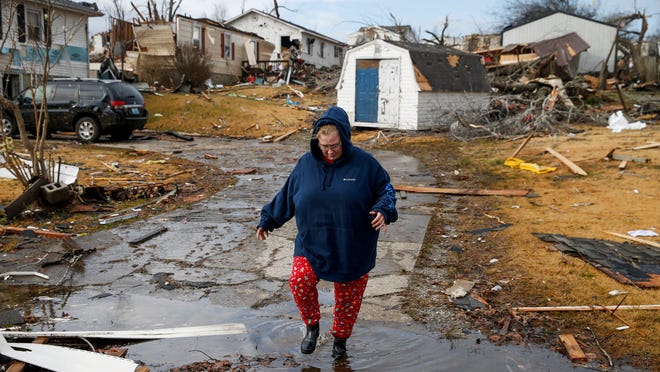
A devastating tornado outbreak across five states Friday night left dozens of people dead and reduced hundreds of homes to rubble, and some scientists say this may be the harbinger of future tragedies as the planet warms.
“The latest science indicates that we can expect more of these huge (tornado) outbreaks because of human-caused climate change,” Penn State meteorologist Michael Mann told USA TODAY.
Spring-like temperatures across much of the Midwest and South last week helped bring the warm, moist air that formed the thunderstorms that spawned the tornadoes. The warmth was at record-breaking levels, meteorologists said, including in Memphis, Tennessee, which soared to a record high of 80 degrees on Friday, the National Weather Service said.
While some of this is due to La Niña – a natural climate pattern that usually brings warmer-than-normal winter temperatures across the southern U.S. – scientists also expect atypical, warm weather in the winter to become more common due to climate change:
Northern Illinois University severe weather researcher Victor Gensini told USA TODAY that these type of events are exactly what climate models say will occur as the climate warms. “The unusual warmth had a big impact on the tornado outbreak,” he said.
Jennifer Francis, a senior scientist at Woodwell Climate Research Center, told the Guardian that climate change was “making some of the ingredients needed to create an outbreak like this more likely.”
“The atmosphere has more fuel in it now, both in terms of heat and moisture,” Francis said. “The large dip in the jet stream that created the clash between warm, tropical air and cold, Arctic air – another necessary ingredient – is also more likely to occur in our changed climate.”
Dan DePodwin, the director of forecast operations for AccuWeather, told USA TODAY that “because we know the climate’s warming, there’s usually the potential for more moisture and more sort of rich moisture to be present at different times of the year than had been the case previously. In order to have an outbreak like this, you need warm, moist air, and in this case it comes from the Gulf of Mexico.”
More:Kentucky governor confirms 64 dead after devastating weekend tornadoes: ‘Undoubtedly there will be more’
Gensini said it’s as if the Gulf of Mexico is “running a fever.”
DePodwin added that “I think the warm December certainly played a role. We haven’t had a lot of cold fronts make their way all the way down into the Gulf of Mexico yet so that can sometimes help cool off the sea surface temperatures.”
“The worst-case scenario happened. Warm air in the cold season, middle of the night,” said John Gordon, a National Weather Service meteorologist in Louisville, Kentucky.
In addition, so-called “Tornado Alley” is shifting farther east away from the Kansas-Oklahoma area and into states where Friday’s killer twisters hit. The USA TODAY Network recently talked with scientists and experts and examined years of tornado data to determine that millions of Americans living in the South are now at an even greater risk for tornadoes than those in the Plains.
More:‘Tornado Alley’ is expanding: Southern states see more twisters now than ever before
The latest science also indicates that the combination of these factors is increasing over time, particularly in the winter months in the south-central and southeastern states, Mann said. “The latest science also indicates a trend toward more intense, destructive tornadoes,” he said. “The tornado that hit Mayfield, Kentucky, was at the upper end of the scale, with radar-measured winds that neared 300 mph.”
Kentucky Gov. Andy Beshear said Monday that 64 deaths were confirmed in his state alone and that “undoubtedly there will be more.” He said the victims ranged in age from 5 months to 83 years.
“This was a very large outbreak,” Mann said.
One of the twisters – if it is confirmed to have been just one – likely broke a nearly 100-year-old record for how long a tornado stayed on the ground in a path of destruction, experts said.
The previous record for a long-track tornado was from 1925, when the F-5 Tri-State Tornado traveled 219 miles through Missouri, Illinois and Indiana, according to the Conversation, an online news agency. The “Quad-State Tornado,” as this tornado has been nicknamed, is expected to break that record.
Looking ahead, AccuWeather meteorologist Jonathan Porter told USA TODAY that while more strong to severe storms are possible later this week in portions of the South, they are unlikely to match the ferocity of last weekend’s outbreak.
Contributing: Jorge Ortiz and John Bacon, USA TODAY; The Associated Press
Powered by WPeMatico