
Budget 2021: Sunak promises new post-Covid economy
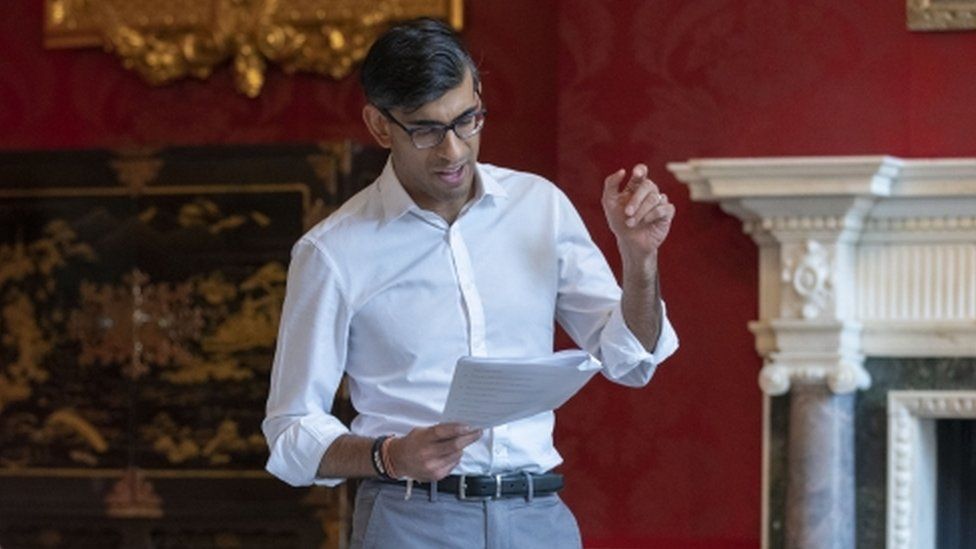
Image source, UK governmentChancellor Rishi Sunak will set out his Budget this afternoon, pledging that it will start “the work of preparing for a new economy” post-Covid.
Spending plans for transport, health and education have been unveiled in the press – but Mr Sunak is under pressure to help people with rising prices.
Later, he will fill in the gaps of his Budget – and how he will pay for his promises.
Policies include £5.9bn for NHS England and pay rises across the public sector.
But the Treasury has already asked departments to find “at least 5% of savings and efficiencies from their day-to-day budgets” – so it is clear not every area will get the same treatment.
And Labour has warned the spending pledges do not go far enough to make up for tax and price hikes, leading to a rising cost of living.
Policies already unveiled from the chancellor’s Budget include:
- £6.9bn for English city regions to spend on train, tram, bus and cycle projects – including the £4.2bn promised in 2019 alongside funding for buses announced by the PM in 2020
- £5.9bn for NHS England to tackle the backlog of people waiting for tests and scans
- A rise in the National Living Wage from £8.91 per hour to £9.50, to come into effect from 1 April
- £2.6bn to be spent on creating 30,000 new school places for children with special educational needs and disabilities
- £1.6bn over three years to roll out new T-levels for 16 to 19-year-olds and £550m for adult skills in England
You can read more on the announcements the government has already made here.
Mr Sunak will announce the rest of his plans after Prime Minister’s Questions at about 12:30 BST.
One of the pre-announced policies is the end to a pay freeze for public sector workers – such as teachers, nurses and police officers – but ministers have so far refused to say whether it will be a real-terms rise by being higher than inflation.
Pay for most frontline workforces is set by independent pay review bodies and No 10 has said it could not “prejudge that process”.
Commons speaker Sir Lindsay Hoyle was angered by the unprecedented number of spending plans that were given to the media before Mr Sunak’s big speech – with Sir Lindsay telling MPs that ministers used to “walk” if they briefed about a Budget.
Traditionally the government is expected to make key policy announcements to MPs first before talking to the press, as they are the elected representatives who can hold them to account in debates.
The break in tradition – deemed “not acceptable” and “discourteous” by the Speaker – also became a feature during the pandemic, with a number of announcements made at press conferences rather than in Parliament.
A No 10 spokesman said they “recognised the importance of parliamentary scrutiny” and they “always listen very carefully to the Speaker”.


Whisper it. After the economy took an absolute hammering during the pandemic, might the chancellor tomorrow actually be in a much cheerier political mood than he could have predicted?
During his Budget warm-up in the last few days, Rishi Sunak has already totted up promises of around an extra £20bn of spending, as well as announcing how some of the cash that was already promised is going to be carved up.
Hold on for a second though. On the specifics, there is no guarantee that unfreezing the wages of 2.5 million workers in England will mean they get pay rises that aren’t eroded by inflation.
The same goes for increases for workers on low pay, and cuts to universal credit will pinch too.
Having treated us all to cosy snaps of him and his Labrador, Nova, and him hard at work in his athleisure wear, Rishi Sunak wants to give the political impression that he’s a chancellor we can all be comfortable with – careful with our money, but not afraid to spend it on things that matter, who has modern Tory instincts, but won’t ditch the party’s traditions.
But remember Budget warm-ups are just that. However many announcements there have already been, however carefully the photographs of the prep have been thought through and selected, what matters is what he actually says at lunchtime on Wednesday.
What matters are the numbers – what’s in black and white – in the end.
Read more from Laura here.
On the eve of his speech, Labour’s shadow chancellor Rachel Reeves issued a call to the government to create “a more resilient economy and take the pressure off working people”.
She said if Labour was in power, it would “ease the burden on households, cutting VAT on domestic energy bills immediately for six months”.
“And we would not raise taxes on working people and British businesses, while online giants get away without paying their fair share,” she added.
There were no more announcements from Mr Sunak the night before his speech, but in a statement he said: “[This] Budget begins the work of preparing for a new economy post-Covid.
“An economy of higher wages, higher skills, and rising productivity. Of strong public services, vibrant communities and safer streets.
“An economy fit for a new age of optimism. That is the stronger economy of the future.”
Ex-Tory chancellor Philip Hammond told BBC Newscast the government should not use higher wages as “a bung” to secure the support of low income voters.
“The instinct to send a message to business that we need to invest more capital rather than just relying on cheap labour, I think is the right instinct, I would support that,” he said.
“But I suspect there is also a bit of an instinct, which says there’s a lot of people out there who are on low wages who voted for us in 2019, perhaps for the first time, so let’s give them a bit of a bung. And that is a rather less economically sound instinct.”
Adam Scorer, chief executive of fuel poverty charity National Energy Action, warned it was going to be a “brutal and bitter winter for millions of householders” who were unable to bear the costs of energy price rises.
He called for the chancellor to find a way to put some of the extra tax receipts raised by the price increases back in the pockets of the most vulnerable.


Are you affected by issues covered in this story? Do you have any questions for our experts? Email haveyoursay@bbc.co.uk.
Please include a contact number if you are willing to speak to a BBC journalist. You can also get in touch in the following ways:
If you are reading this page and can’t see the form you will need to visit the mobile version of the BBC website to submit your question or comment or you can email us at HaveYourSay@bbc.co.uk. Please include your name, age and location with any submission.
Related Topics
Powered by WPeMatico