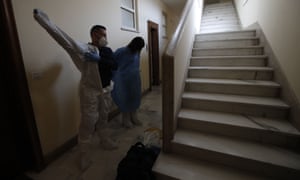
A time-consuming but crucial part of the vaccination campaign in Italy are house-to-house visits to deliver doses to the elderly. The country has the world’s second-oldest population and tends to care for its aged at home rather than in institutional facilities.
Alessandro Tarantino and Gordon Walker have been out in the Lazio region for Associated Press with Dr. Elisa Riccitelli and nurse Luigi Lauri on their rounds. The doctor and nurse manage just 12 shots a day — six in the morning, six in the afternoon, but it is seen as a vital job in protecting Italy’s most vulnerable from the pandemic.
Doctor Elisa Riccitelli, right, and nurse Nurse Luigi Lauri wear protective gear before entering in the home of an elderly Rome resident. Photograph: Alessandra Tarantino/AP
In the Lazio region around Rome, some 30,000 people over age 75 and with conditions that made it impossible for them to get to vaccination centers
To make sure they hit all their appointments on time — one vial of Pfizer for the morning six, one vial for the afternoon — the local public health center struck a deal with Uber so its visiting vaccination teams could have a dedicated car and driver. The 500 free rides from Uber cut down on time spent finding parking spots in Rome’s notoriously congested streets.
And when they ring a doorbell, they are welcomed inside like heroes.
“It’s really a very nice feeling,” Riccitelli said. “We often vaccinate bedridden patients who cannot move, the extremely elderly, so the feeling is that we’re doing something really useful.”
“I feel amazing, like yesterday and the day before that, amazing,” said 96-year-old Patrizia Cumbo, who has dementia, after she got her shot. She lives with her caregiver and received her jab from the living room recliner where she spends most of her days.
Doctor Elisa Riccitelli with Patrizia Cumbo, 96 years old, after she had a dose of Covid vaccine in her home. Photograph: Alessandra Tarantino/AP
A bedridden Giorgio Tagliacarne, 85, said he hoped his jab would spell the end of a year of isolation, which was particularly acute given he and his wife used to sail for pleasure around the world.
“This way now maybe my grandchildren can come visit me, which until now is something I have avoided,” he said, as his wife sat nearby.
Doctor Elisa Riccitelli talks with 85-year old Giorgio Tagliacarne, in his bed, after he received a dose of Covid vaccine at his home in Rome. Photograph: Alessandra Tarantino/AP
Riccitelli and Lauri take full precautions when they enter each home, donning dedicated protective gear and masks. Riccitelli notes relevant medical data and handles consent forms, while Lauri prepares and administers the vaccine, which they carry in an insulated bag to keep it cold. Then they wait 15 minutes to ensure there are no adverse reactions, and move onto the next appointment.
“Fortunately we have never seen any side effects,” Riccitelli says. “After 15 minutes we say goodbye with a big smile.”
The relentless drumbeat continues in the UK about whether people will be able to have foreign holidays this summer. Transport minister Grant Shapps has been doing the media round this morning. He has told Sky News “We need to do this carefully.”
He also suggested that it would be May when the government would be able to inform people which countries they will be allowed to visit without quarantine on return.
In a move that will anger people opposed to the imposition of vaccine passports, Shapps revealed that Britain is working on using the existing National Health Service coronavirus app to show that people have received their Covid-19 vaccine for international travel.
“It will be the NHS app that is used for people when they book appointments with the NHS … to be able to show that you’ve had a vaccine or that you’ve had testing, and I’m working internationally with partners across the world, to make sure that that system can be internationally recognised,” he said.
Reuters report he will be chairing a meeting of G7 transport ministers from the G7 next week to discuss the plan further.
Britain has earmarked 17 May as being the earliest date when international travel would be allowed for non-essential reasons, with a “traffic light system” based on individual countries’ Covid risk levels.
“The data does continue to look good from a UK perspective notwithstanding those concerns about where people might be travelling to and making sure that we’re protected from the disease being re-imported,” Shapps said.
Here’s Alistair Smout for Reuters with a recap of the overnight news of that Public Health England study which says that Covid-19 vaccines deployed in England can cut transmission of the coronavirus by up to a half, in addition to the protection the shots offer against symptomatic infection.
Smout reports that the new research showed that people who became infected with the coronavirus three weeks after receiving one dose of Pfizer or AstraZeneca vaccine were between 38% to 49% less likely to pass it on to household contacts compared to those who were unvaccinated.
The shots also stop a vaccinated person developing infection to start with, reducing the risk by around 60% to 65% from four weeks after one dose of either vaccine.
UK health minister Matt Hancock has said: “This study is the most comprehensive real-world data showing they also cut transmission of this deadly virus. It further reinforces that vaccines are the best way out of this pandemic as they protect you and they may prevent you from unknowingly infecting someone in your household.”
The study included over 57,000 contacts from 24,000 households in which there was a lab-confirmed case that had received a vaccination, compared with nearly 1 million contacts of unvaccinated cases.
Leading scientists are urging the UK to share the Covid vaccines it has bought with India and other nations, to tackle the soaring death toll and reduce the spread of the virus and new variants around the world.
Sir Jeremy Farrar, the director of the Wellcome Trust, said rich countries including the UK that have bought up most of the vaccine supply “urgently need to start sharing these doses with the rest of the world, alongside national rollouts in their own countries, and through the Covax programme. And they must set out a timetable for how these donations will be increased as they vaccinate more of their populations domestically.”
Writing in the Guardian, Farrar called on the UK to lead the world, through its presidency of the G7. “We have already vaccinated over half of our population – including those who are most at risk from Covid-19. In fact, the UK has given almost as many doses to its own citizens than Covax has been able to ship to 120 countries in dire need of jabs,” he said.
Covax, the UN-based initiative to get vaccines to the most vulnerable 20% of the population of every country, has managed to deliver only a fifth of the doses of the Oxford/AstraZeneca vaccine expected by May, because of global shortages and problems with supply.
One in four people in high-income countries are now protected but only one in 500 in low-income countries, where unvaccinated health workers are still putting their lives on the line. The US has announced it will give India 60m doses of the Oxford/AstraZeneca vaccine, which is not yet licensed for use in the US.
Farrar said sharing vaccines was in every country’s self-interest. “The shores Covid now rages upon may seem distant to some, but the reality is that so long as the virus continues to spread in other countries, it continues to be a threat to everyone. If we allow Covid-19 to keep spreading, it will go on evolving, increasing the risk of new variants that could cross borders and evade vaccines and treatments.”
Read more of Sarah Boseley’s report here: Leading scientists urge UK to share Covid vaccines with poorer nations
We mentioned below about the crematorium crisis in New Delhi that is the latest manifestation of the devastating wave of Covid sweeping India.
We’ve just published a video showing workers constructing the makeshift pyres that are mentioned in the main story. However, some readers might find this video distressing:
Crematoriums in Delhi forced to build makeshift pyres as India’s Covid crisis intensifies – video
Spain has opened up the prospect of tourists returning to the country from June under a Covid digital health certificate scheme.
Fernando Valdés, Spain’s secretary of state for tourism, told the World Travel & Tourism Council summit in Mexico on Tuesday that the programme – under which tourists could show they have been vaccinated, tested negative or recently recovered from the virus – would prove “fundamental to offering travellers certainty”.
Read the full story here:
Trade unions in Britain are calling for an immediate public inquiry into the country’s nearly 130,000 deaths from Covid – one of the worst totals in the world.
The Trades Union Congress said the inquiry should examine whether workers were kept safe enough after about 15,000 people of working age died from Covid in England and Wales.
It comes as new accounts emerge of the power struggle within Downing Street that saw Boris Johnson at odds with his key advisers over whether to implement a second lockdown in November. The prime minister was against the shutdown.
Data from France has shown that the country’s Covid crisis is beginning to ease as French president Emmanuel Macron plans to relax restrictions in the next few days.
French health authorities said on Tuesday that the number of Covid-19 patients in intensive care units fell by 58 to 5,943, after the tally set a one-year high of 6,001 on Monday, Reuters reports.
A woman rides her bicycle near the Eiffel tower at Trocadero square in Paris. Photograph: Gonzalo Fuentes/Reuters
The total number of people in hospital with Covid-19 also fell, by 315 to 30,281, a 17-day low.
New infections went up by 30,317 over 24 hours but the 3.65% increase versus last Tuesday is the lowest week-on-week rise since 2 January.
India recorded 360,960 new cases in the 24 hours to Wednesday morning according to health ministry data, another new daily global record.
The ministry also said that India’s total number of fatalities had passed 200,000 to stand at 201,187. The Guardian takes its figures for deaths from the Johns Hopkins University tracker, which shows fatalities on 197,984.
The World Health Organization is sending extra staff and supplies to India to help fight the coronavirus pandemic, says the WHO chief, Tedros Adhanom Ghebreyesus, adding: “WHO is doing everything we can, providing critical equipment and supplies, including thousands of oxygen concentrators, prefabricated mobile field hospitals and laboratory supplies.”
WHO chief says the Covid surge in India ‘beyond heartbreaking’ – video
The number of confirmed coronavirus cases in Germany increased by 22,231 to 3,332,532, data from the Robert Koch Institute for infectious diseases showed on Wednesday. The reported death toll rose by 312 to 82,280.
The Indian variant of the virus has been detected in Fiji, sparking fears of a “tsunami” of Covid-19 cases. Pacific editor Kate Lyons reports:
The permanent secretary for health and medical services, James Fong, said six new cases had emerged in quarantine facilities on Tuesday and events in India showed the threat posed by the strain could not be underestimated.
“We cannot let that nightmare happen in Fiji,” he said in a televised address.
Read the full story:
Fires from funeral pyres can be seen at night in New Delhi Photograph: Amarjeet Kumar Singh/SOPA Images/REX/Shutterstock
Hannah Ellis-Petersen, our south Asia correspondent, writes from Delhi about the civilian oxygen army that has stepped into the breach, providing cylinders and oxygen refills free of charge to those in desperate need. Read her full story here:
Crematoriums in the Indian capital of New Delhi are being forced to make makeshift funeral pyres in a measure of the desperate plight facing the country.
Grieving relatives of the dead are having to wait 20 or more hours for a funeral pyre amid an explosion of new Covid cases.
Photographs taken in Delhi on Tuesday showed smoke billowing from dozens of pyres lit in a car park that had been turned into a makeshift crematorium. Elsewhere, workers built makeshift pyres on land outside crematoriums.
You can read the full report here:
America’s leading expert on infectious diseases, Dr Anthony Fauci, has told Guardian Australia’s Melissa Davey that richer countries must give more help to
Dr Fauci calls for global response as Covid infections surge in India – video
New Zealand is donating NZ$1m (US$720,000) to assist with the ongoing Covid-19 crisis in
Good morning/afternoon/evening wherever you are. I’m Martin Farrer and welcome to the Guardian’s live blogging of the coronavirus pandemic.
The situation in India once again dominates our coverage as the Covid crisis in the country continues to worsen: here are the main developments in India to start with: