
Boy Scouts of America plan to exit bankruptcy would pay abuse survivors an average of $6,000 each; survivors object
Boy Scouts of America is proposing to pay $220 million toward a trust to compensate tens of thousands of former members who say they were abused during their time as scouts, according to a statement from the committee that represents survivors in the case.
Another $300 million may come from a voluntary contribution from local councils, the Boy Scouts said in court documents filed Monday, but the local organizations have given no formal commitment.
The number is a fraction of the $1 billion of the organization’s estimated value, and a sliver of the value of its subsidiaries, including local councils as well as various trusts and endowments, which USA TODAY estimates could exceed $3.7 billion.
The proposal is part of a reorganization plan put forth by the nonprofit detailing how it intends to handle the massive child sex abuse case that’s threatening its existence – the largest ever involving a single national organization – and emerge as a viable entity.
It comes a little more than a year after Boy Scouts filed for bankruptcy in federal court in Delaware. At the time, the organization said it faced 275 lawsuits in state and federal courts plus another 1,400 potential claims. Nearly 95,000 claims were filed by the November deadline set by the bankruptcy judge.
The proposed settlement would amount to about $6,000 per claimant, even after the total number of claims is reduced after duplicates are deleted and other reviews. That number assumes an even distribution among survivors and does not reflect issues related to statutes of limitations or specific acts of abuse.
Boy Scouts says it will put forth all unrestricted cash and investments above the $75 million it says it needs to continue operations. It also will contribute its art collection, which includes original Norman Rockwell pieces, as well as two facilities in Texas and its oil and gas interests, consisting of more than 1,000 properties in 17 states.
But the proposal may be dead on arrival. The survivors’ Torts Claimant Committee objects to the plan.
“As a fiduciary to all sexual abuse survivors, the TCC has thoroughly investigated the assets and liabilities of the BSA and its local councils,” the committee said in a statement, “and concluded that the BSA’s reorganization plan woefully fails to adequately compensate sexual abuse survivors or provide any enhanced systematic protections for future generations of Scouts.”
Gill Gayle, an abuse claimant who serves on the committee, said it was only after juries began awarding survivors million-dollar verdicts that Scouts realized “the sum total of paying for their deeds exceeds their monetary value.”
“We’re talking about them trying to get a discount on child abuse, on systematic child abuse that occurred decade after decade after decade,” Gayle said.
As a result of the violent sexual abuse he alleges he suffered as a kid in Scouts, Gayle said he spent $125 to $150 an hour on therapy for 26 years, which was rarely covered by insurance. The Scouts’ proposed settlement would barely reimburse him for that cost alone.
Paul Mones, who tried a landmark case in 2010 that resulted in $19.9 million in damages, said that result should have been a wakeup call for the organization. Instead, he said, it is still trying to go back to business as usual.
“There was a forest fire in their backyard and they were watching television and having dinner and not thinking anything was wrong,” Mones said. “Now the forest fire is at their door and they still think, though the plan will reflect some cutting back, that they can have a plan that will not really inflict any kind of serious pain on them.”
Much about Boy Scout’s finances remains unknown, which could complicate the approval process. What is owned by local councils, and in turn how much of that should go to victims, remains a central point of contention.
More:Boy Scouts files Chapter 11 bankruptcy in the face of thousands of child abuse allegations
More:Boy Scouts abuse claims may become largest case against a single national organization
Another sticking point is how much Boy Scouts deems core to operations or restricted by donors, and thus not available to compensate survivors.
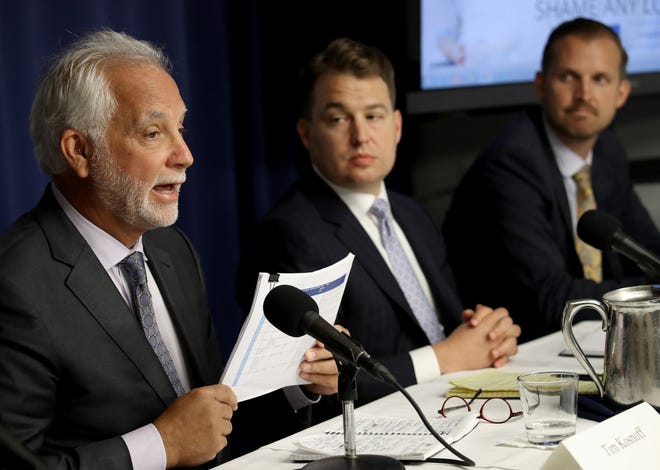
Tim Kosnoff, a lead attorney with the group Abused in Scouting, said the gulf is vast between what assets Boy Scouts have proposed to contribute and what survivors will approve – maybe too vast for the nonprofit to close before it runs out of money. The organization has said it needs to exit bankruptcy by August or risk a cash shortage, citing declines in revenue due to COVID-19 restrictions that have closed Scout camps and diminished fundraising opportunities.
“I just don’t see a plan that would be acceptable to the victims coming together in time for the Boy Scouts,” Kosnoff said. “I think they’re finished. I think they’re out of time.”
Will victims get access to local Scout assets?
As it stands, the plan only contains a commitment from the national organization to request that local councils voluntarily contribute no less than $300 million to a trust for survivors. In exchange, the Boy Scouts are seeking complete and permanent prohibition on any lawsuits – an exchange that is already being rejected by survivors and their attorneys.
In a statement, Michael T. Pfau of Pfau Cochran Vertetis Amala PLLC, who represents 1,000 survivors in the bankruptcy, said it’s obvious that Boy Scouts is trying “conceal the fact that these councils are not paying a fair amount, and worse, they are trying to force abuse survivors to give up their claims for close to nothing.”
As first reported by the Wall Street Journal, roughly 70% of the Scouts’ wealth is held by different legal entities, namely local councils, most of which the national organization has attempted to wall off from the bankruptcy.
In an analysis of 2018 tax filings, the latest available, USA TODAY found more than $3 billion in assets held by more than 380 limited liability corporations – LLCs – connected to local scout groups. More than $1.35 billion were securities, while another $2.18 billion were land, buildings and equipment, and net depreciation.
That land includes thousands of acres in the mountains of Colorado and camps with views of Pikes Peak to a 700-acre donation by John D. Rockefeller, Jr. in northern New Jersey, a stone’s throw from New York City and some of the most expensive real estate in the world.
From a 53,000 square-foot office building in Atlanta to a mile-and-half along the shores of the Lake of the Ozarks and a beachfront campground in St. Croix, the local councils’ assets are vast, and don’t stop at the U.S. border. The Transatlantic Council even boasts camps along the Adriatic Sea in Croatia and in the heart of the Swiss Alps.
The USA TODAY Network found $101 million in local councils’ property in the state of New York alone, and another $16 million in Tennessee, according to tax records.
Those numbers may not come close to reflecting current worth.
Laurie Styron, executive director of CharityWatch, said fixed assets on nonprofits’ balance sheets are based on historical costs. If the Scouts own property sold or donated to the organization many decades ago, those values may not match current fair market value.
In an extreme case, the Las Vegas Area Council listed the value of its land, buildings and equipment at more than $13 million on its 2019 tax filings. Its holdings include nearly 1,150 acres in the Las Vegas Valley, the Spencer W. Kimball Scout Reservation.
The bulk of the land was sold by the Bureau of Land Management in 1958 to what is now the Las Vegas Area Council under a program that sells and leases federal land to local and state entities or nonprofits for recreational or public use. The council was restricted from selling or transferring the land for 25 years.
It was marketed by a commercial broker for high-end development on behalf of the council in 2019. The listing price: $90 million.
That property has not sold. W. Todd Walter, the Scout executive for the Las Vegas council, told USA TODAY the Tort Claimants Committee “hired an independent, third-party land appraiser who just appraised that land at $12-to-14 million.”
Several of the Tennessee properties owned by Scout councils are listed in the state’s real estate assessment data with appraised values of $0. That includes 2,400 acres at Skymont Scout Reservation on the edge of the Cumberland Plateau, listed with a sale price of $0 in 1975, around the time the camp opened. Comparable property in the area is currently for sale at anywhere from $2,400 to $20,000 an acre, according to a USA TODAY analysis.
Styron said real estate valuations can be complicated for a number of reasons, including whether easements or mineral rights are attached or because of local and state ordinances.
Attorneys say, thus far, bankruptcy proceedings have done little to provide clarity. The claimants committee has been frustrated over responses to requests for financial documentation, particularly from local councils.
Boy Scouts’ assets are spread across a web of trusts and LLCs, which limits their availability to creditors and obfuscates the exact value of the organization.
“It’s a great planning tool,” Foohey said. “Bankruptcy or not, putting money and property in different corporate entities is a way to section off liability in a corporation or in a company whether it be nonprofit or for profit.”
Foohey also said the only entities obligated to contribute to the victims’ fund are the national organization that filed for bankruptcy and its insurers.
Local council assets present “a dilemma for the bankruptcy court“
Boy Scouts has insisted that the local councils are distinct and financially independent from the national organization and have argued they should be “protected parties” in the bankruptcy case.
The national organization describes its relationship with local councils as essentially a franchise arrangement: The national group handles the development of Scout content and structure, licensing, training, human resources, legal support and information technology; the local councils oversee troops and Cub Scout packs in a region and run day-to-day operations.
The bankruptcy judge has granted an injunction on all litigation against the councils. The Boy Scouts organization seeks to keep that injunction, and upon agreement of its proposed plan, to indemnify the councils “to the fullest extent lawful, from and against any and all claims, liabilities, losses, actions, suits, proceedings, third-party subpoenas, damages, costs and expenses (including full reimbursement of all fees and expenses of counsel), as incurred, related to, arising out of, or in connection with any Abuse Claim,“ according to Monday’s court filings.

The filings continued that after the proposed plan would take effect, any abuse claims against the councils “permanently and forever stayed.“
Victims’ attorneys are fighting against Boy Scout’s assertion that the councils are discreet entities, noting that they operate hand-in-glove with the national organization and the councils have significant liability for their part in allowing child abuse to continue unabated for decades. They’ve also accused Boy Scouts of using the division to shield assets from survivors since a majority of the organization’s wealth lies at the local rather than national level.
More:Tensions rise over local councils’ role in Boy Scouts bankruptcy proceedings
Moreover, suspicions have been raised that local councils have deliberately hidden assets.
The Torts Claimants Committee accused the Middle Tennessee Council of transferring several camps into a trust last summer, breaking an agreement that they wouldn’t sell or transfer properties without notifying the creditors. The trust does not mention Scouts in its name or description, but the court ordered the addition of language stipulating that Boy Scouts may still have interest in the property.
Kosnoff said victims are being asked to sign off on a plan to vacate their rights to sue without a clear picture of the councils’ financial status.
“You’re asking victims to release not just BSA national but all these councils and you have no idea what the value is of the assets?” Kosnoff asked. “Is it $2 billion in assets? Is it $10 billion? $20 billion? Nobody can answer that question, which is going to be I think a dilemma for the bankruptcy court.”
Foohey said local councils may face significant liability if they don’t contribute to the fund, even though by law they may not have to. Hundreds of lawsuits against local councils in states across the country are currently in limbo as long as the injunction remains in place.
Boy Scouts is hoping to address those claims via the victims’ fund within the bankruptcy case. But the councils won’t be released from liability if they don’t contribute enough to the fund to get approval from survivors. At that point, the state cases will resume and Kosnoff said potentially thousands more will be filed.
Contributing Charter organizations, which sponsor local troops, are similarly seeking indemnity from the sex abuse cases. In the plan, their proposed contribution was not specified, with Boy Scouts saying it would be supplemented later.
What assets are available to pay victims?
Further complicating the road to finalizing a deal is how much of Boy Scouts of America money is legally available to compensate victims.
In January, the Torts Claimant Committee filed a complaint over the national organization’s assertion that $667 million of their $1 billion estate, more than 60%, is off limits to victims.
Nonprofit organizations are often bound by restrictions in how donations can be used, experts say. For example, if a donor gives money to a program for direct aide to veterans, “the charity is not allowed to use it on buying new software for their website,” Styron said.

The committee has argued that much of Boy Scouts’ restricted assets are, in practice, unrestricted, including three high adventure bases. Those camps – Philmont in New Mexico, Northern Tier in Minnesota and Florida Sea Base – have an asserted value of more than $60 million, according to court records.
The committee says they have been used to gain a line of credit from JP Morgan Chase, thus indicating they are not restricted. In court records, Boy Scouts said that line of credit, more than $62 million, is also restricted.
More than half of the assets Boy Scouts says are restricted relate to the Summit Bechtel Reserve in West Virginia, which amounts to $345 million.
Another wildcard in the total financial picture for survivors is the amount of contribution from Boy Scout’s insurers. Though they will be on the line to contribute based on the policies held by Boy Scouts, the amount has yet to be determined.
In recent weeks, insurers affiliated with insurers including Chubb and Hartford Financial Services Group, have questioned the validity of claims filed by law firms representing survivors arguing that they were poorly vetted and lack sufficient information.
In court documents, the insurers also requested permission to question survivors as well as any attorneys who signed claim forms for them. Those forms typically must be signed by claimants but, as the deadline approached, attorneys signed hundreds on behalf of their clients.
Robbie Pierce, who said he was abused by a Boy Scout camp employee when he was 13, welcomes oversight of the claims, saying that, if anything, the number is still low. He said he spoke with other members of his troop who chose not to come forward even though they were abused by the same camp employee.
“We’re not opportunistic. We’re a bunch of Boy Scouts,” Pierce said. “That used to be the word for honest and helpful people.”
What’s next in the bankruptcy case?
Attorneys for survivors in the case say they will file a response to the plan with their own proposals, while the claimant’s committee will raise its own objection. Gayle said the committee is focused on making sure all survivors are taken care of.
“The strategy here is to have everyone recognized for what they suffered, first of all, and to have that respected, and to get as much help to them as we can,” Gayle said. “There isn’t a single man who suffered this abuse that does not have issues that need to be addressed.”
“We have guys in all kinds of situations and, frankly, we have men who already committed suicide and haven’t been able to get through their suffering.”
If an agreement can’t be reached, or Boy Scouts can no longer turn a profit, the court may turn to liquidation, Foohey said. That might not be a bad outcome for some survivors, she said, referencing the bankruptcy of the Weinstein Company after its founder, Harvey Weinstein, was accused of sexual harassment and assault over decades.
“Seeing the Weinstein Company taken apart publicly might have been a satisfying outcome,” Foohey said.
Another result may be similar to the case with Bikram Yoga. The brand of hot yoga filed for bankruptcy protection in recent years as a result of sexual misconduct allegations against its founder. Its studios rebranded as Bode Yoga, which Foohey said is another option for Boy Scouts, with the local councils rolling over into a rebranded entity.
Kosnoff, who has grown more fatalistic about the potential outcome, says a quick liquidation may result in a better deal for survivors because Boy Scouts will stop hemorrhaging money for attorneys’ fees, which eats into the pot for potential victims.
Some survivors, however, are upset by the idea of an end to Boy Scouts, and hope the nonprofit survives.
Michael Lipari, abused at 14 by a Scout leader whom he helped convict of child abuse, said he wants to see the organization acknowledge its mistakes and do everything in its power to make the organization safe.
“They should take some of the survivors and say, ‘We’re going to have you on a board of advisors on how we can better ourselves and be an organization that can protect children. What are some of your recommendations?’ ” Lipari said.
“But the first step is they need to own it. Truly own every aspect of it. It’s a lot bigger than just putting money into a pot.”
Pierce said that when he first filed a claim, he wanted to find a way for Boy Scouts to continue to exist while helping those it harmed.
“Once I saw the numbers, and that there were literally thousands of us, I thought this organization has done so much more damage to young men than it has ever done good in this world. And they have always prioritized keeping themselves afloat over the safety of the young men,” Pierce said. “The fact that they’re now trying to find a way to continue to exist and pay us the least that they can, it’s not a surprise. That is their playbook.”
“There are too many of us for this ever to be fair, to ever get back a fraction of what we’ve lost.”
Cara Kelly is a reporter on the USA TODAY investigations team, focusing primarily on pop culture, consumer news and sexual violence. Contact her at carakelly@usatoday.com, @carareports or CaraKelly on WhatsApp.
Contributing: Mariah Timms of The Tennessean, Rachel Axon
Powered by WPeMatico