
Tesla Can’t Afford To Abandon Its Solar Roof Fantasy
By any objective measure, Tesla’s (TSLA) solar energy business is in a state of persistent decline. The solar installation industry as a whole, meanwhile, has evolved into commodity business. Thus, Tesla’s recent decision to sell residential solar panels at a 16% discount appears destined to result in even steeper losses.
Of course, Tesla was supposed to have an answer to the commodity pricing problem: The Solar Roof.
But there’s just one problem: The Solar Roof is still vaporware, three years after it was first unveiled.
Tesla has continued its Solar Roof charade for years, even as evidence has mounted that the technology is still in the design phase. It has had no choice but to do so, since abandoning the project, or admitting its flawed origins, would expose Tesla to potentially life-threatening legal liability.
SolarCity: The Original Sin
Markets were introduced to the Solar Roof in 2016, as CEO Elon Musk fought frantically to convince investors to back his plan to merge Tesla with SolarCity, a residential solar installer (which happened to be run by Musk’s cousin and in which Musk himself had invested considerable capital).
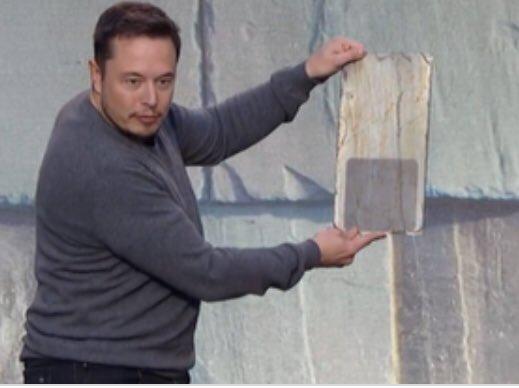
Musk called the SolarCity deal a “no-brainer” in light of Tesla’s own solar energy and battery storage plans. He rolled out the Solar Roof tiles to an eager audience in the run-up to the shareholder vote, claiming that installations would ramp up rapidly. The tiles’ elegant design was meant to differentiate the Solar Roof from existing cookie-cutter solar panel products.
Source: CNBC
Ultimately, Musk got his way, and Tesla acquired SolarCity for $2.6 billion in stock. Tesla also took on SolarCity’s eye-watering $2.9 billion debt load.
A Dwindling Business
Given Musk’s grandiose promises about Tesla’s future leadership in solar installations, one would might expect to see growth in the segment since the SolarCity acquisition. In reality, however, the opposite has proven to be the case. Tesla’s solar installations have fallen consistently, as have revenues and margins, while thousands of its employees in the segment have been fired during successive waves of headcount reduction.
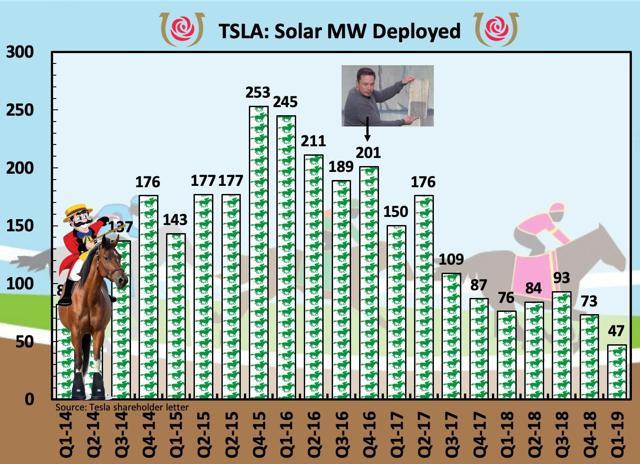
Source: Tesla, @TeslaCharts
Meanwhile, Tesla’s Gigafactory 2 in Buffalo, NY, which is co-occupied by Panasonic (OTCPK:PCRFY), has failed to mature into the solar cell manufacturing juggernaut it had promised. Musk had managed to squeeze New York taxpayers for a whopping $750 million in subsidies based on a promise to invest billions more into the state, as well as create thousands of good-paying tech jobs.
The reality, as with so many of Musk’s claims, has fallen short of what was promised. Today, the Buffalo Gigafactory is mostly a Panasonic operation and its solar cell production largely supplies other, non-Tesla, solar companies.
Still No Sign of the Solar Roof
Tesla rarely fails to reference the Solar Roof in its investor communications, usually to promise yet again that the long-awaited production ramp is imminent. This was the official company line throughout 2017 and most of 2018. Then, in its earnings letter for the third quarter of 2018, dropped a bombshell:
“Due to the complexity of Solar Roof, we continue to iterate on the design of the product via intensive reliability testing, and we also continue to refine the installation process. Accordingly, we expect to ramp production more quickly during the first half of 2019.”
In other words, the Solar Roof, which had been sold as a marketable product in late 2016, was still going through iterative designs as of late 2018. As of now, the Solar Roof continues to be little more than a phantom, with a mere handful of installations reported each quarter.
Actions Speak Louder Than Words
Judging from Tesla’s actions over the past year, it seems fairly easy to conclude that its solar business is being deliberately wound down. Falling installations, elimination of retail sales jobs, and liquidation pricing all point in this direction.
Yet, in spite of the growing body of evidence to the contrary, Tesla continues to claim that all is well. Indeed, when recently asked why it would move several non-solar jobs to Buffalo when the solar segment is supposedly on the cusp of explosive growth, a Tesla spokesperson stayed on message:
“In addition to scaling production of Solar Roof, Tesla is also diversifying its presence in Buffalo by manufacturing and assembling Supercharger and energy storage components at Gigafactory 2.”
Given the stark reality of the situation, the big question becomes: Why is Tesla so committed to the Solar Roof narrative?
A Trap of Musk’s Own Devising
A host of lawsuits were filed against Tesla in the wake of the SolarCity merger. One major shareholder suit, which alleges Musk used the merger to self-deal, has been wending its way through the Delaware courts for the past couple years. In April 2019, the plaintiffs won class certification from the Delaware Chancery Court.
Now Musk’s big promises of 2016 are coming home to roost. Tesla cannot afford to lose a major class-action judgment. Musk claimed in a staff email last week that Tesla had just 10 months of cash runway at the current burn rate, despite having recently raised more than $2 billion from sales of debt and equity. A nine-figure judgment is certainly not beyond the realm of possibility, given the scale of the merger, which resulted in billions of dollars of shareholder dilution, as well as billions more in new liabilities.
The sorry saga of the Solar Roof must be understood in the context of these looming potential liabilities.
Investors’ Eye View
Musk used the promise of the Solar Roof to sell investors on the merger, claiming it was on the cusp of mass production. He claimed further that the Solar Roof would actually be cheaper than conventional roofs. With these claims now proven to have been – at best – wishful thinking, Tesla could find itself in serious civil jeopardy. In its efforts to avoid this eventuality, it has sustained a kind of kabuki theater in which the Solar Roof ramp is always imminent, but never here.
But Tesla’s solar act has begun to wear out its welcome even with believers. The MIT Technology Review, for example, which once included the Solar Roof among its “10 Breakthrough Technologies 2016,” has now labeled it a “flop.”
Bottom Line: Tesla is sitting on potentially catastrophic civil legal liabilities out of Musk’s highly questionable SolarCity acquisition. The company’s attempts to backfill in the succeeding years have failed thanks to the Solar Roof’s persistent failure to materialize as a viable commercial product. Musk gambled that he could get the product working before the music stopped. Increasingly, it looks like that gamble failed spectacularly. Shareholders will likely end up paying a steep price.
Disclosure: I am/we are short TSLA. I wrote this article myself, and it expresses my own opinions. I am not receiving compensation for it (other than from Seeking Alpha). I have no business relationship with any company whose stock is mentioned in this article.
Powered by WPeMatico